



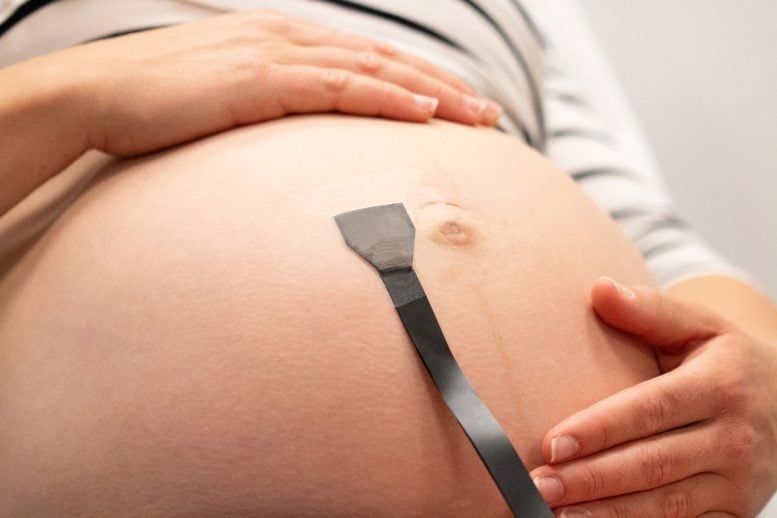
A new soft ultrasound patch is designed to provide long-term, hands-free monitoring of fetal health in real time.
Engineers at the University of California, San Diego, have developed a soft, wearable ultrasound patch that can continuously monitor a fetus for hours at a time while maintaining reliable performance even as the fetus and umbilical cord move throughout pregnancy.
The device could help physicians identify complications earlier in high-risk pregnancies. During clinical testing, the patch detected prolonged abnormal fetal signals in one case, prompting an early Cesarean delivery. Researchers said the intervention may have helped save the baby’s life. The technology could also improve access to prenatal care in low-resource regions where trained ultrasound specialists and continuous monitoring are often unavailable.
The findings were published in Nature Biotechnology.
“Wearable ultrasound technology has the potential to enable continuous prenatal monitoring and improve pregnancy outcomes in ways that were previously not possible,” said study co-first author Geonho (Tom) Park, a chemical and nanoengineering PhD student at the UC San Diego Jacobs School of Engineering. Park co-led the study with fellow UC San Diego Jacobs School of Engineering co-first authors Yizhou Bian, Hao Huang, and Sai Zhou.
Autonomous Tracking Overcomes Fetal Movement Challenges
Most prenatal ultrasounds provide only a brief look at fetal health and require trained sonographers to operate the equipment. In contrast, the new patch is designed to remain on the body and continuously monitor a baby’s anatomy and blood flow in real time without the need to manually position an ultrasound probe.
“To comprehensively monitor mothers and babies over the amount of time needed to catch complications like preeclampsia, you need a system that can work continuously and largely on its own,” Bian said. “That is why the sensing depth, functional capabilities, and autonomy of this ultrasound technology are critical.”
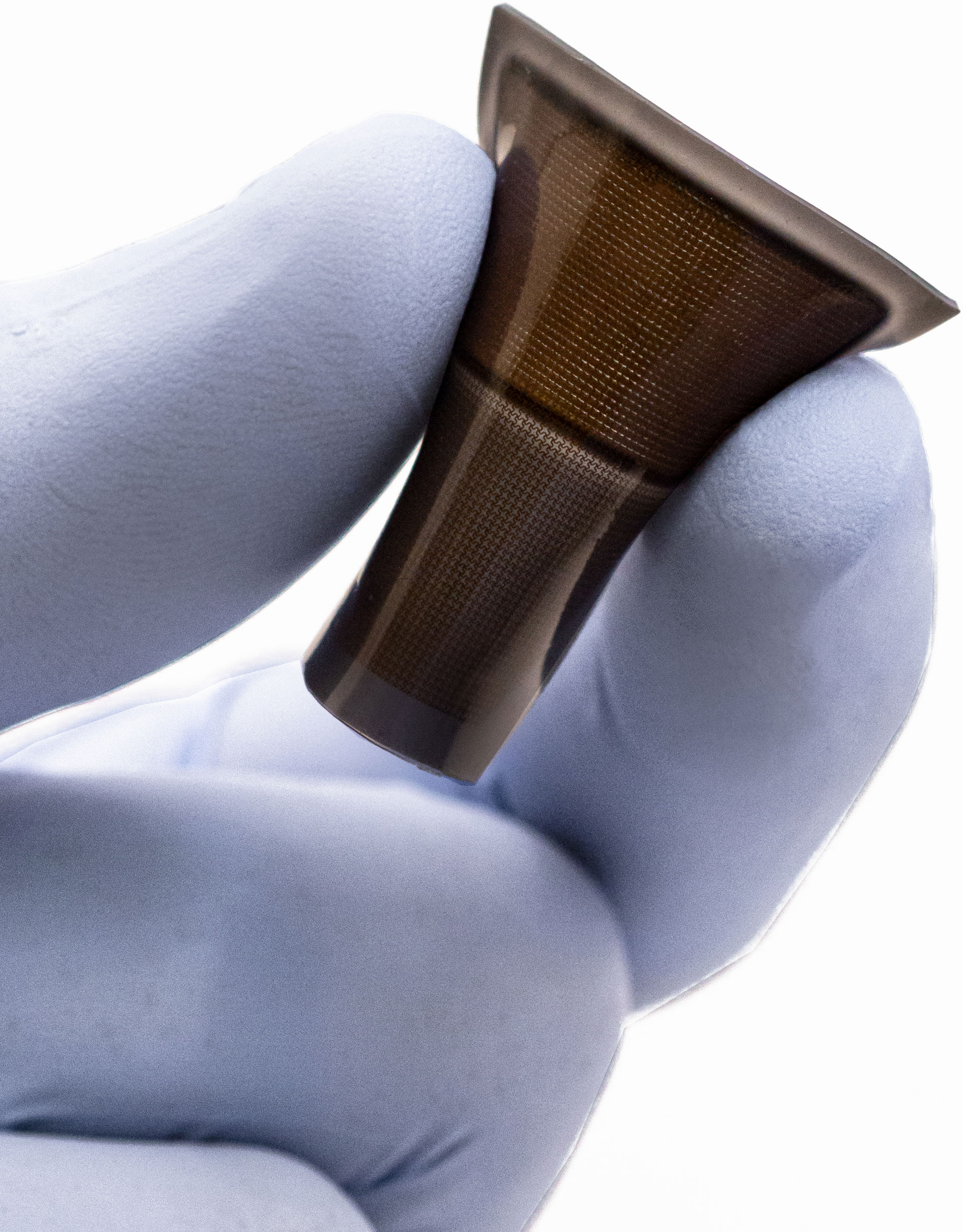
One of the biggest obstacles to long-term fetal monitoring is the constant movement of both the fetus and the umbilical cord. To solve this problem, the researchers created autonomous tracking algorithms that can automatically locate and follow the umbilical cord as it moves. This allows the patch to collect consistent measurements even when the mother or fetus changes position.
“With continuous monitoring, we were able to observe dynamic fluctuations in blood flow that would likely be missed with conventional ultrasound exams,” Huang said.
Early Detection of Pregnancy Complications
“Our system even detected an abnormality during one of our clinical visits,” Park added. “That pregnancy later resulted in a delivery at 29 weeks, and it demonstrated how continuous monitoring could help identify complications much earlier than we can today.”
The study builds on more than a decade of wearable ultrasound research in the laboratory of chemical and nanoengineering professor Sheng Xu at UC San Diego. Xu’s team has previously developed wearable ultrasound systems for applications including noninvasive central blood pressure monitoring, mobile heart monitoring, and gesture-based control of robotic devices. The work was carried out in the Aiiso Yufeng Li Family Department of Chemical and Nano Engineering at the UC San Diego Jacobs School of Engineering.
For the new study, researchers tested the patch in a multicenter clinical trial conducted at Jacobs Medical Center at UC San Diego Health and the John Radcliffe Hospital at the University of Oxford. The patch produced measurements that closely matched those collected using standard handheld ultrasound devices.
Extensive Clinical Testing Demonstrates Broad Applicability
The researchers gathered continuous monitoring data over periods of several hours from 62 pregnancies. The group included both healthy pregnancies and pregnancies affected by gestational diabetes, preeclampsia, high blood pressure, and abnormal fetal growth.
The team now aims to integrate the patch into a compact electronic platform that could eventually enable fully wireless operation.
Reference: “Fetal monitoring for high-risk pregnancies using a wearable ultrasound patch” by Geonho Park, Yizhou Bian, Hao Huang, Sai Zhou, Siyu Qin, Muyang Lin, Xinyi Yang, Aaron Lee, Anand Ramkumar, Mariana Tome, Jayne Lander, Xiangjun Chen, Shenghan Wang, Pranavi Bheemreddy, Liam Stanton, Ren Sheng, Guihuan Guo, Mabel Shehada, Ruotao Wang, Alexa Roa, Chengchangfeng Lu, Wentong Yue, Ray S. Wu, Xiaoxiang Gao, Hongjie Hu, Amer Yaghi, Mark Liu, Lawrence Impey, Sally L. Collins, Aris T. Papageorghiou, Louise C. Laurent, Keith A. Wear, Antoniya Georgieva and Sheng Xu, 26 May 2026, Nature Biotechnology.
DOI: 10.1038/s41587-026-03140-1
This work was supported by Wellcome Leap (HER01430), the National Institutes of Health (1R01EB033464-01 and 1R01HL171652-01), and Accelerating Innovation to Market at UC San Diego.
Never miss a breakthrough: Join the SciTechDaily newsletter.
Follow us on Google and Google News.
Full article can be found at: https://scitechdaily.com/breakthrough-ultrasound-patch-tracks-blood-flow-and-fetal-health-in-real-time/


