



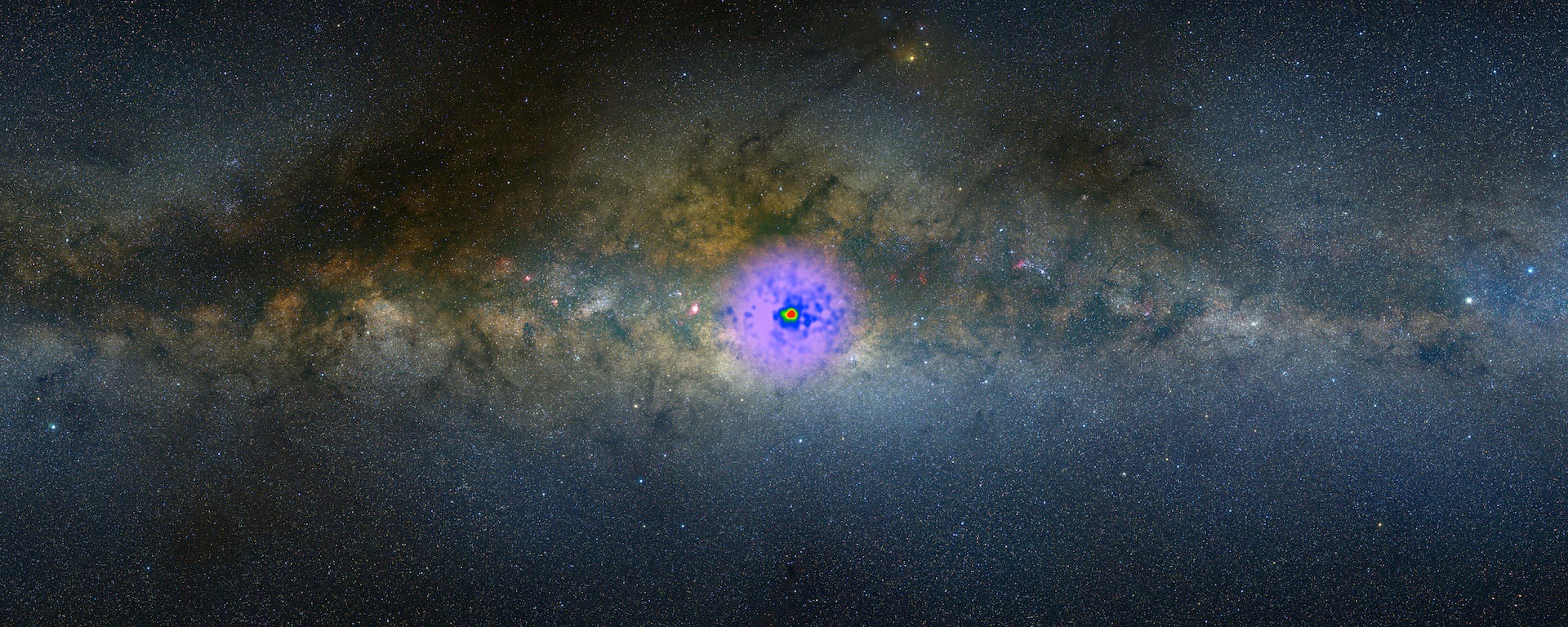
Scientists have taken a fresh look at the Milky Way’s mysterious gamma-ray glow using machine learning and uncovered evidence that reshapes a long-running debate.
Scientists have taken a fresh look at one of astronomy’s most enduring mysteries, and dark matter is still in the running. An international team led by researchers at the University of Vienna and Lawrence Berkeley National Laboratory used machine learning to revisit the mysterious gamma-ray glow known as the Galactic Center Excess (GCE), which surrounds the center of the Milky Way. Their findings suggest that dark matter remains a viable explanation for the signal and should not yet be dismissed. The research was published in Physical Review Letters.
A Mysterious Gamma-Ray Glow at the Heart of the Milky Way
The Galactic Center Excess is a faint, roughly spherical glow of gamma rays that stretches across thousands of light years around the center of our galaxy. Since it was first identified, scientists have debated what could be producing it.
One possibility is self-annihilating dark matter, a hypothetical process predicted by some theories. Another leading explanation is a large but unseen population of rapidly spinning neutron stars called millisecond pulsars. Despite years of study, neither idea has been confirmed.
“Interpreting the signal is particularly difficult because the Galactic Center is an exceptionally bright and crowded region of the gamma-ray sky,” explains Florian List, study author and researcher at the University of Vienna.
Machine Learning Adds Missing Photon Energy Data
Previous statistical analyses generally favored the pulsar explanation. However, those studies overlooked one important detail: the energy of each detected gamma-ray photon.
To address that limitation, the researchers created a machine-learning system trained on more than one million simulated gamma-ray observations. For the first time, the model analyzed both the locations of the photons and their energies simultaneously, allowing the team to compare the competing explanations more completely.
Dark Matter Remains a Plausible Explanation
Adding photon energy information dramatically changed the results. Earlier studies suggested the glow came from relatively bright but unresolved light sources, known as point sources. The new analysis indicates that, if those sources are actually millisecond pulsars, they would have to be extraordinarily faint.
“Our new analysis shows that the sources would have to be so faint that they would be almost indistinguishable from the emission expected from annihilating dark matter,” says Nick Rodd, study author and scientist at the Lawrence Berkeley National Laboratory.
If the pulsar explanation is correct, the findings imply there would need to be at least 35,000 of these objects clustered near the center of the Milky Way. That is far more than the few hundred to few thousand sources assumed in some earlier studies.
The Debate Over the Galactic Center Excess Continues
“The origin of the Galactic Center Excess is one of the longest-running debates in astrophysics,” says Florian List. “Our work does not show that dark matter is responsible for the signal. However, it suggests that it is still too early to rule out this possibility.”
While the study does not provide direct evidence that dark matter is producing the gamma-ray glow, it weakens one of the strongest arguments that had been used against that idea. As a result, dark matter remains a credible explanation for one of the Milky Way’s most intriguing cosmic mysteries.
Reference: “Energy Distribution of the Galactic Center Excess’s Sources” by Florian List, Yujin Park, Nicholas L. Rodd, Eve Schoen and Florian Wolf, 12 June 2026, Physical Review Letters.
DOI: 10.1103/dkcq-6y4f
Never miss a breakthrough: Join the SciTechDaily newsletter.
Follow us on Google and Google News.
Full article can be found at: https://scitechdaily.com/the-milky-ways-mysterious-glow-may-be-dark-matter-after-all/


