



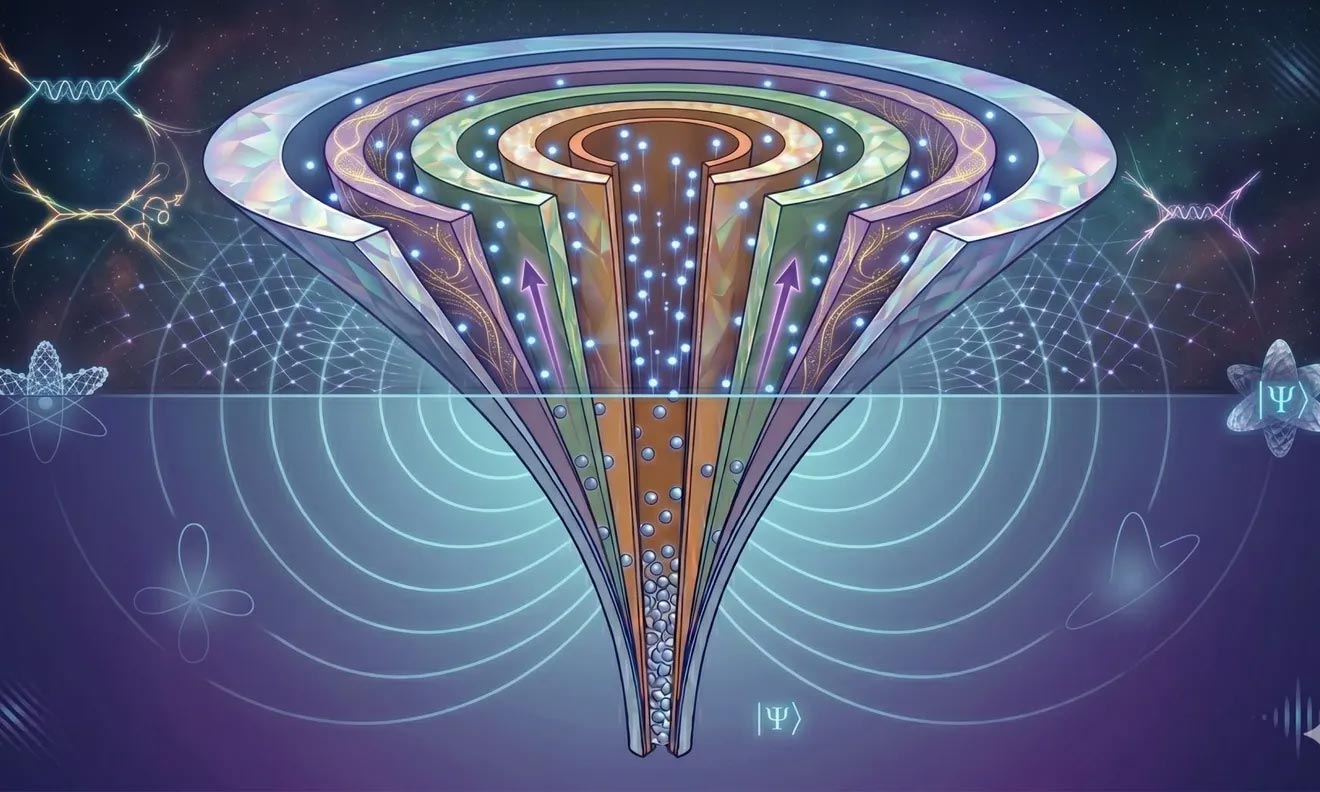
Scientists have engineered a never-before-seen quantum state, uncovering a new phase of matter with hidden order beyond conventional theory.
Researchers have shown that an unusual quantum state known as a “fractional Fermi sea” can be deliberately created, opening the door to a previously unknown phase of matter. The work, published in Physical Review Letters, was carried out by the Nägerl group together with theoretical collaborator Alvise Bastianello of the CNRS and Université Paris-Dauphine. The study provides the theoretical foundation for recent experimental work led by Hans-Christoph Nägerl’s group in the Department of Experimental Physics.
Creating a New Quantum State
The team focused on ultracold Cesium atoms confined to a single dimension. By repeatedly changing how strongly the atoms interacted, cycling them between strong repulsion and strong attraction, they pushed the system far from its normal equilibrium state. Rather than behaving according to the well-established Tomonaga-Luttinger liquid theory, the atoms entered an entirely new critical phase of matter.
This newly predicted phase arises through a process called quantum engineering, showing that carefully controlled interaction cycles can produce forms of quantum matter that do not occur naturally under ordinary conditions.
What Is a Fractional Fermi Sea?
At extremely low temperatures, quantum particles normally arrange themselves according to well-defined rules. As Alvise Bastianello explains: “Fermions, for instance, stack neatly into the available energy states to form the so-called ‘Fermi sea’. But what happens if one forces interacting atoms to continuously cycle through extreme conditions, smoothly shifting them from strongly repelling each other to strongly attracting each other?”
The researchers found that this carefully designed interaction cycle drives atoms from their ground state into a highly excited yet surprisingly organized non-equilibrium state. They call this unusual arrangement a “fractional” Fermi sea because the particles appear to obey a reduced occupancy rule.
“Instead of simply heating the system, the interaction cycle reorganizes the atoms into a new many-body state,” says Yi Zeng, the study’s lead author. “This gives us a controlled way to explore quantum matter beyond the usual equilibrium paradigms.”
Hidden Order Beyond Established Theory
The fractional Fermi sea displays several distinctive features. Mathematical relationships between the particles produce pronounced ripples known as Friedel oscillations, along with characteristic decay patterns across all levels of repulsive interaction.
These signatures clearly separate the new state from Tomonaga-Luttinger liquids, which have long served as the standard framework for describing one-dimensional quantum systems.
“This state is highly excited, but it is not random,” says Hanns-Christoph Nägerl, the group’s leader. “It has a hidden order that becomes visible in its correlations.” He adds: “We are not yet sure how we should name these new quasiparticles. Perhaps ‘super-Fermions’?”
A New Frontier for Quantum Simulation
The unique behavior of fractional Fermi seas points to an entirely new exotic critical phase of matter and provides researchers with a new way to investigate universal quantum behavior using cold atom simulators.
As Nägerl explains: “The discovery of fractional Fermi seas shows how far we can push quantum simulation: not only reproducing known models, but creating and probing states that go beyond established paradigms.”
A companion paper describing the experimental realization of fractional Fermi seas through quantum simulation is currently under review.
References:
“Exotic Critical States as Fractional Fermi Seas in the One-Dimensional Bose Gas” by Alvise Bastianello, Yi Zeng, Sudipta Dhar, Zekui Wang, Xudong Yu, Milena Horvath, Grigori E. Astrakharchik, Yanliang Guo, Hanns-Christoph Nägerl and Manuele Landini, 9 June 2026, Physical Review Letters.
DOI: 10.1103/j3s5-gjpf
“Realization of fractional Fermi seas” by Yi Zeng, Alvise Bastianello, Sudipta Dhar, Zekui Wang, Xudong Yu, Milena Horvath, Grigori E. Astrakharchik, Yanliang Guo, Hanns-Christoph Nägerl and Manuele Landini, 19 May 2026, arXiv.
DOI: 10.48550/arXiv.2602.17657
Never miss a breakthrough: Join the SciTechDaily newsletter.
Follow us on Google and Google News.
Full article can be found at: https://scitechdaily.com/fractional-fermi-sea-physicists-discover-a-new-phase-of-matter-beyond-established-theory/


