



Rising mantle temperatures and two heat surges may explain why some Hawaiian volcanoes grew exceptionally large.
A 3500 km (2200 mile) trail of volcanoes records the Pacific plate’s slow passage over the Hawaiian hotspot. Instead of cooling through time as geologists have generally expected, the mantle plume beneath this chain appears to have warmed by about 250°C (480°F) during the past 47 million years.
The finding, led by Earth scientists at the University of Hawai‘i at Mānoa, challenges the long-held view that hotspots begin extremely hot and gradually lose heat. Reported in Earth and Planetary Science Letters, the research also links two periods of unusually high plume temperature to the formation of the largest volcanoes in the Northwestern and Main Hawaiian Island chain.
The Hawaiian Ridge contains 65 volcanoes formed as the Pacific plate moved across a hotspot fed by hot material rising from deep within Earth. Yet the amount of lava produced along the ridge varies by roughly 100-fold, leaving researchers to determine what caused such dramatic differences in volcano size.
A group led by Michael Garcia, Emeritus Professor of Earth Sciences in the UH Mānoa School of Ocean and Earth Science and Technology, examined olivine basalts from 16 volcanoes. The researchers tested four possible explanations for the changing lava volume: variations in lithosphere thickness, differences in the magma source, changes in the speed of the Pacific plate, and shifts in mantle plume temperature.
“It was a major surprise to find such a strong, direct correlation between mantle temperatures and volcano size,” said Garcia. “Other potential explanations simply failed to explain the data.”
A new thermometer tracks ancient heat
To reconstruct temperatures deep beneath the volcanoes, the researchers developed a new “geothermometer” that estimates how hot the lava was when it originally formed in the mantle. They then compared those temperature estimates with updated measurements of volcano size derived from extensive ocean floor surveys.
Together, the two datasets allowed the researchers to trace how plume temperature and lava production changed across millions of years along the Hawaiian Ridge.
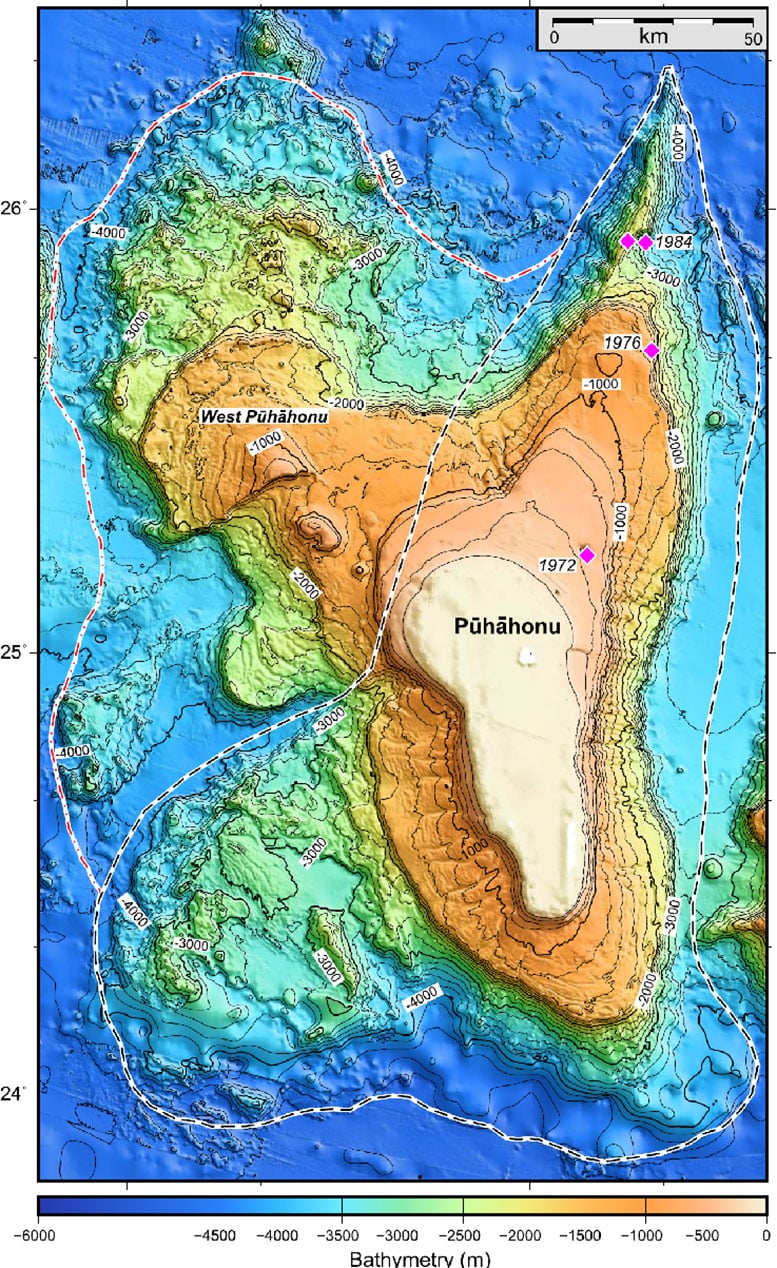
Two heat surges built the giants
The results point to an overall rise in lava temperature interrupted by two major surges of heat. One occurred 14-20 million years ago and produced Pūhāhonu, the largest and longest-lived shield volcano formed within the past 60 million years. The second occurred 0-6 million years ago and contributed to the formation of the Hawaiian Islands.
“The development of the new geothermometer allows one to better understand the history of volcanoes and why some are larger than other volcanoes,” Garcia added.
The researchers suggest that the plume’s long-term warming may be connected to the movement of dense, hot material within the lowermost mantle.
Reference: “Taking the temperature of the Hawaiian plume using multiple geochemical approaches: Evidence for secular heating from 47 Ma to present” by Michael O. Garcia, Keith D. Putirka, Jonathan P. Tree and Brian R. Jicha, 8 June 2026, Earth and Planetary Science Letters.
DOI: 10.1016/j.epsl.2026.120055
Never miss a breakthrough: Join the SciTechDaily newsletter.
Follow us on Google and Google News.
Full article can be found at: https://scitechdaily.com/the-hotspot-beneath-hawaii-is-getting-hotter-defying-a-long-held-geological-theory/


