



New research calls for aquatic deoxygenation to be recognized as a critical planetary process under threat.
Oxygen is declining across oceans, coastal waters, rivers, lakes and streams, threatening the organisms and chemical processes that depend on it. A review led by researchers at UC San Diego’s Scripps Institution of Oceanography warns that this widespread deoxygenation is moving Earth toward an “unsafe space,” with some effects potentially lasting beyond human timescales.
The researchers examined how aquatic deoxygenation, meaning the loss of dissolved oxygen from marine and freshwater environments, interacts with the nine processes included in the Planetary Boundaries framework. Introduced in 2009, the framework identifies major Earth systems and evaluates how human activity is pushing them beyond the conditions that support a stable and resilient planet.
Those nine boundaries cover climate change, ocean acidification, biodiversity loss, atmospheric aerosol loading, stratospheric ozone depletion, freshwater change, land use change, chemical pollution and biogeochemical flows (including the nitrogen cycle). The authors argue that dissolved oxygen should also be included.
Oxygen loss threatens planetary stability
“The health and stability of our planet depends on the health and stability of aquatic ecosystems, which need oxygen to function normally,” said lead author Erica Ferrer, a Scripps Oceanography alumna and current postdoctoral scholar at UC Santa Barbara’s National Center for Ecological Analysis and Synthesis. “This study is designed to elevate the profile of aquatic deoxygenation as a global threat and show that it does not operate in isolation.”
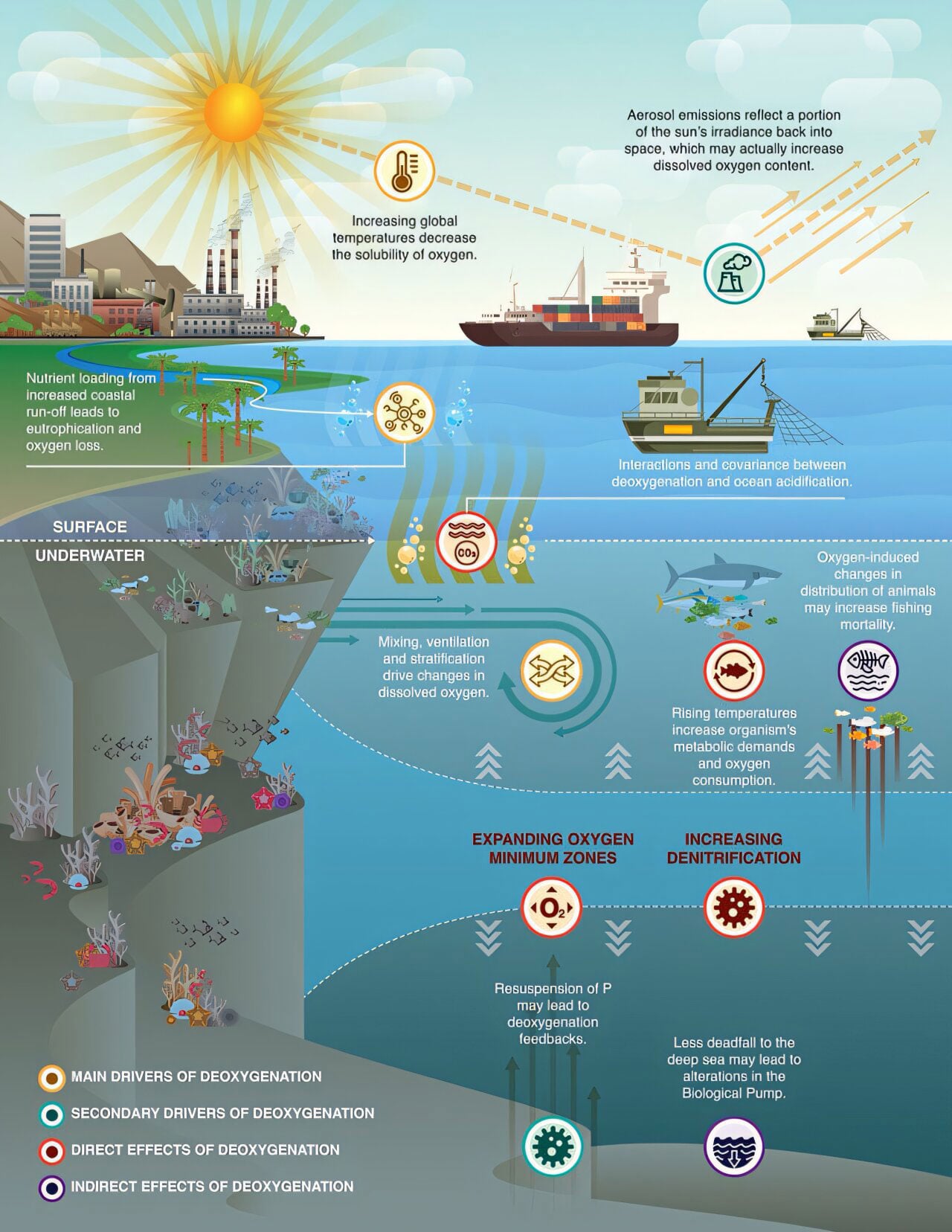
Human-caused warming, excess nutrient pollution and changes in the circulation that carries oxygen into deeper waters are the primary drivers of aquatic deoxygenation. Declining oxygen interferes with biological and chemical processes that help regulate Earth’s climate while threatening organisms ranging from microbes to fish and sharks. Marine mammals can also be affected despite breathing at the surface because oxygen loss changes their habitats, prey, and surrounding food webs.
Scientists call for a new boundary
Ferrer and senior author Lisa Levin, a biological oceanographer at Scripps, developed the idea for the review after attending COP25, the United Nations Climate Change Conference held in Madrid in 2019. They hope the work encourages researchers and policymakers to address aquatic deoxygenation together with the other pressures affecting Earth’s systems.
“Adding aquatic deoxygenation to the Planetary Boundaries framework will help us understand its impacts on Earth system stability,” said Ferrer. “Mitigating its impacts represents a critical component of maintaining biodiversity and climate.”
Reference: “Abundant interactions and feedbacks between aquatic deoxygenation and the other planetary boundaries suggest “unsafe” levels of oxygen loss with far-reaching impacts” by Erica M. Ferrer, Yassir A. Eddebbar, Shailja Gangrade, Lillian R. McCormick, Ariel K. Pezner, De’Marcus Robinson, Véronique Garçon, Kevin C. Rose and Lisa A. Levin, 30 June 2026, Limnology and Oceanography.
DOI: 10.1002/lno.70434
Ferrer conducted this review as part of her doctoral research at Scripps, supported by the National Science Foundation’s Graduate Research Fellowship Program and graduate funds from Scripps and UC San Diego, followed by postdoctoral support from UC Santa Cruz and UC Santa Barbara.
Never miss a breakthrough: Join the SciTechDaily newsletter.
Follow us on Google and Google News.
Full article can be found at: https://scitechdaily.com/scientists-warn-a-silent-oxygen-crisis-is-spreading-through-earths-waters/


