



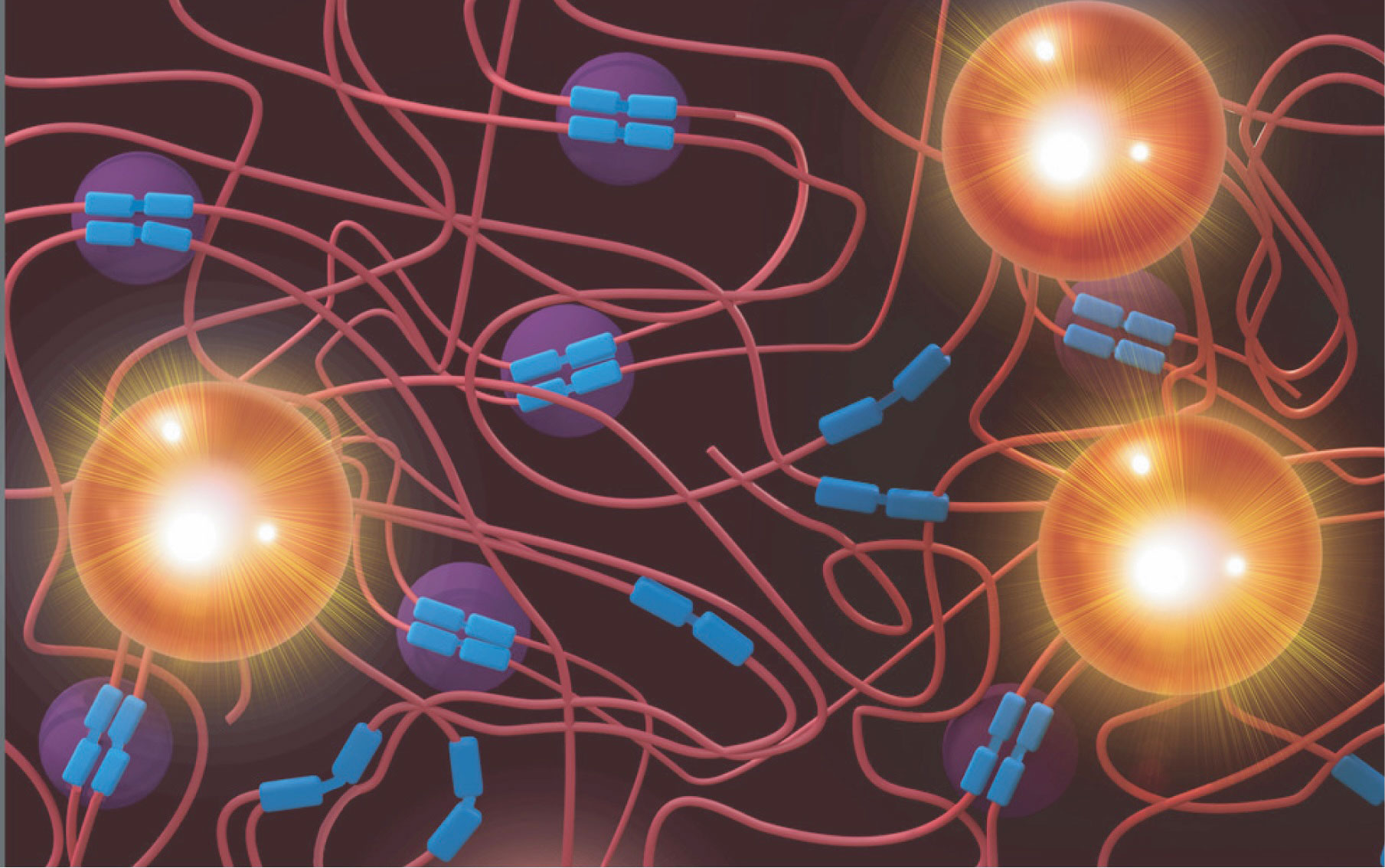
A new approach to controlling atomic vibrations in polymers may offer a path toward lightweight materials that better resist both heat transfer and fire.
What if a plastic could block heat more effectively without becoming weaker, heavier, or harder to manufacture? Researchers at the University of Massachusetts Amherst say they may have found a new way to make that possible by changing how heat moves through a material at the atomic level.
Their approach targets one of the biggest challenges in thermal insulation. Most insulating materials rely on trapped air because air is a poor conductor of heat. That strategy works well for products like foam insulation, but introducing air pockets into plastics often comes at a cost, reducing strength and durability while complicating manufacturing. Instead of adding empty space, the UMass team focused on disrupting the microscopic vibrations that carry heat through solid materials.
The work could help pave the way for a new class of plastics that are lightweight, flexible, flame-retardant, and better at limiting heat transfer. Potential applications range from spacesuits and spacecraft to energy-efficient buildings and electronics that require improved thermal management.
Rethinking How Heat Moves Through Plastics
Thermal conductivity measures how easily heat travels through a material. Metals, for example, conduct heat efficiently because energy can move quickly through their atomic structure. Insulating materials slow that process down.
Rather than altering a material’s structure by adding pores or air-filled cavities, the UMass researchers examined heat transport at the atomic scale. In solids, heat is largely carried through vibrations that pass from atom to atom. The more organized and accessible those vibrational pathways are, the more efficiently heat can move.
Yanfei Xu, the study’s corresponding author and an assistant professor in the Riccio College of Engineering at UMass Amherst, and her team set out to interfere with those pathways.
Xu compares normal heat transfer to a bucket brigade, where firefighters efficiently pass buckets of water down a line. In this analogy, the firefighters represent atoms, and the buckets represent heat. When everyone is coordinated, heat moves quickly from one place to another.
The researchers wanted the opposite effect.
Creating “Slow Chaos”
To slow heat transfer, the researchers used vibrational engineering to disrupt that coordination. Rather than behaving like an organized line of firefighters passing large buckets, the polymer acts more like a group of disorganized toddlers. Each moves in a different direction and can carry only small cups instead of large buckets, making heat transfer much less efficient.
Because of this disrupted motion, heat moves through the material more slowly. In an initial test using a polymer hybrid made from polyurethane and tetrahydroxy deoxybenzoin triazole, the team found that this “slow chaos,” as Xu describes it, reduced thermal conductivity by 17%. The material also showed flame-retardant properties.
Although the reduction in thermal conductivity was relatively modest in this early study, Xu believes the findings reveal an important new way to control heat flow in materials.
“There is a lot of potential,” she says. “By reducing the density of thermally accessible vibrational channels available for heat transport, thermal conductivity is suppressed. The materials remain dense, mechanically compliant, and flame-retardant.”
Reference: “Suppressing thermal transport in nonporous polymer hybrids by limiting thermally accessible vibrational modes” by Henry Worden, Mihir Chandra, Yijie Zhou, Zarif Ahmad Razin Bhuiyan, Mouyang Cheng, Krishnamurthy Munusamy, Duc Nghiem, Weiguo Hu, Weibo Yan, Siyu Wu, Ruipeng Li, Zhang Jiang, Anna Chatterji, Shengjia Zhang, Ilia N. Ivanov, Jihua Chen, Jack C. Lasseter, Mengru Jin, Derin Abitagaoglu, Qing Tu, Todd Emrick, Jun Liu and Yanfei Xu, 18 May 2026, Materials Horizons.
DOI: 10.1039/D6MH00633G
The research was supported by the U.S. National Science Foundation, the Federal Aviation Administration, and UMass Amherst.
Never miss a breakthrough: Join the SciTechDaily newsletter.
Follow us on Google and Google News.
Full article can be found at: https://scitechdaily.com/scientists-create-plastic-that-blocks-heat-without-losing-strength/


