



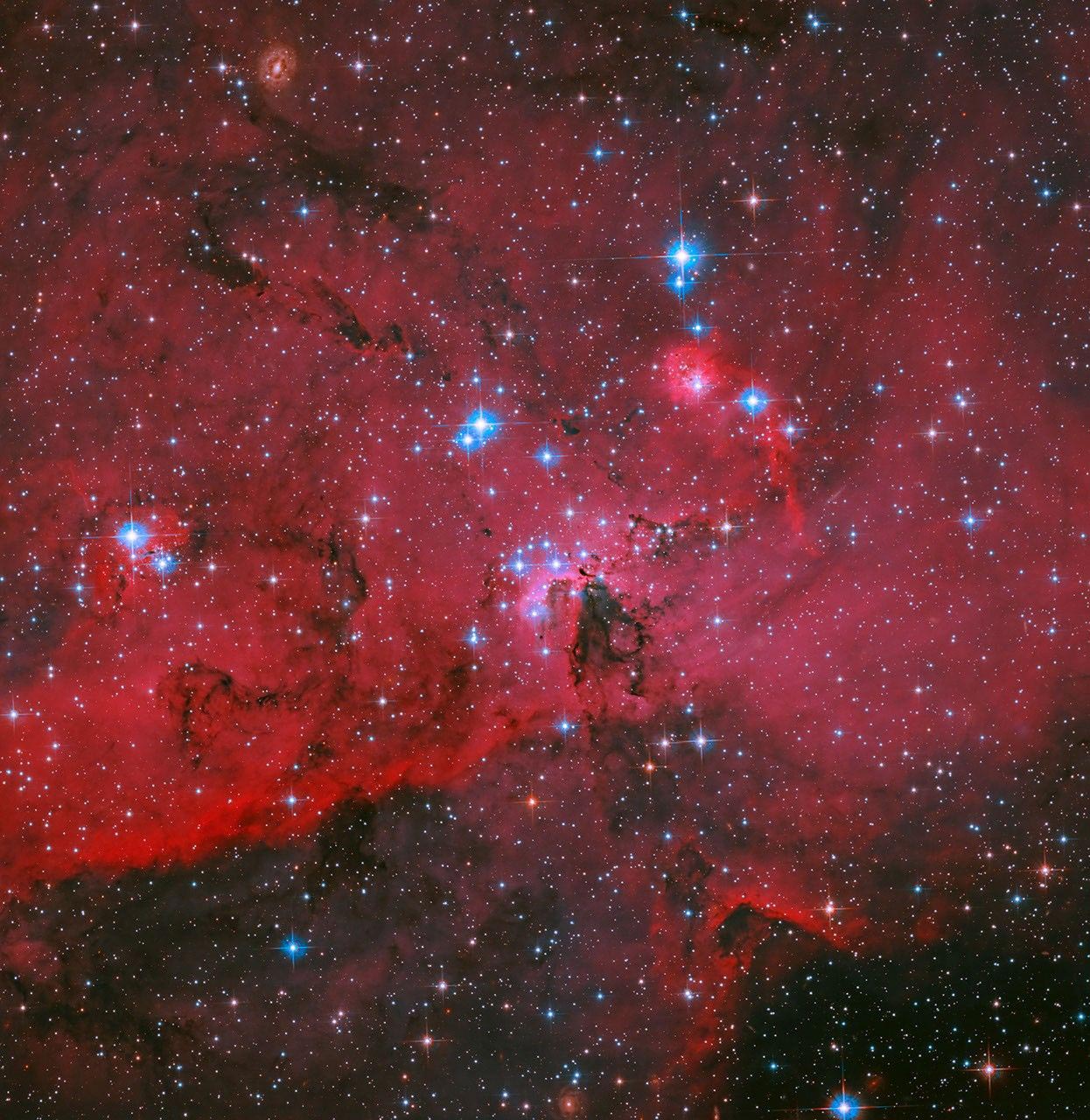
NASA’s Hubble Space Telescope has captured a breathtaking view of the stellar nursery LH 95, where brilliant blue and white stars sparkle against glowing crimson clouds of gas, creating a scene that resembles fireworks fading into a smoky night sky.
Located in the Large Magellanic Cloud, a dwarf galaxy that orbits the Milky Way, LH 95 is home to both newly forming low-mass stars and massive blue giants. Together they make up what astronomers call a stellar association, one of many found throughout the neighboring galaxy.
Massive Stars Shape Their Cosmic Neighborhood
The largest blue stars in LH 95 have at least three times the Sun’s mass and dominate the region. Their intense ultraviolet radiation and powerful stellar winds heat the surrounding hydrogen gas while carving and sculpting the nebula over time.
Dense ribbons of dust remain visible as dark filaments cutting across the glowing gas because they are more resistant to erosion from the energetic stars.
The colors in the Hubble image represent different wavelengths of light rather than what the human eye would naturally see. Blue corresponds to shorter visible wavelengths, while red includes longer visible wavelengths along with some near-infrared light. The nebula’s vivid crimson glow comes from hydrogen alpha emissions, a key signature of active star formation.
Thousands of Stars Still Growing
Hydrogen alpha light helps astronomers identify extremely young stars hidden within the glowing gas. Observations of LH 95 revealed many stars that are still collecting material from surrounding disks of gas and dust.
In total, the region contains about 2,500 stars that have accumulated nearly all of the mass they need but have not yet begun nuclear fusion. Known as pre-main-sequence stars, these young objects formed as clouds of gas collapsed under gravity and continue to contract. Once conditions in their cores become hot and dense enough, they will begin fusing hydrogen and officially become full stars.
Young Stars Grow Longer Than Expected
By examining these developing stars, researchers confirmed that the rate at which they gather material naturally slows as they age. At the same time, the observations revealed that this growth process can continue for several million years, longer than some previous assumptions suggested.
That finding gives astronomers a clearer picture of how young stars continue gaining mass and how the disks surrounding them gradually evolve before disappearing.
Multiple Generations of Stars Share the Same Nursery
The Hubble observations also show that LH 95 has produced stars over an extended period instead of through a single burst of activity. Different generations of stars exist side by side, indicating that star formation has continued across millions of years.
The most massive star visible in the image, located slightly left of center near the top, contains roughly 60 to 70 times the Sun’s mass. Surprisingly, it appears to be about one million years younger than most of the surrounding stars, which are estimated to be around 4 million years old. Massive stars like this consume their fuel rapidly and eventually end their lives in spectacular supernova explosions.
A Nearby Laboratory for Studying Stellar Birth
Because LH 95 contains such a rich population of developing stars and has less dust blocking the view than comparable regions within the Milky Way, it provides astronomers with an exceptional opportunity to study how stars form and evolve at relatively close range.
For more than three decades, NASA’s Hubble Space Telescope has transformed our understanding of the universe with discoveries like these. Its observations are complemented by other NASA missions, including the James Webb Space Telescope, which observes in infrared light, and the upcoming Nancy Grace Roman Space Telescope, currently scheduled for launch in late summer.
Never miss a breakthrough: Join the SciTechDaily newsletter.
Follow us on Google and Google News.
Full article can be found at: https://scitechdaily.com/nasas-hubble-captures-a-stunning-red-white-and-blue-stellar-nursery/


