



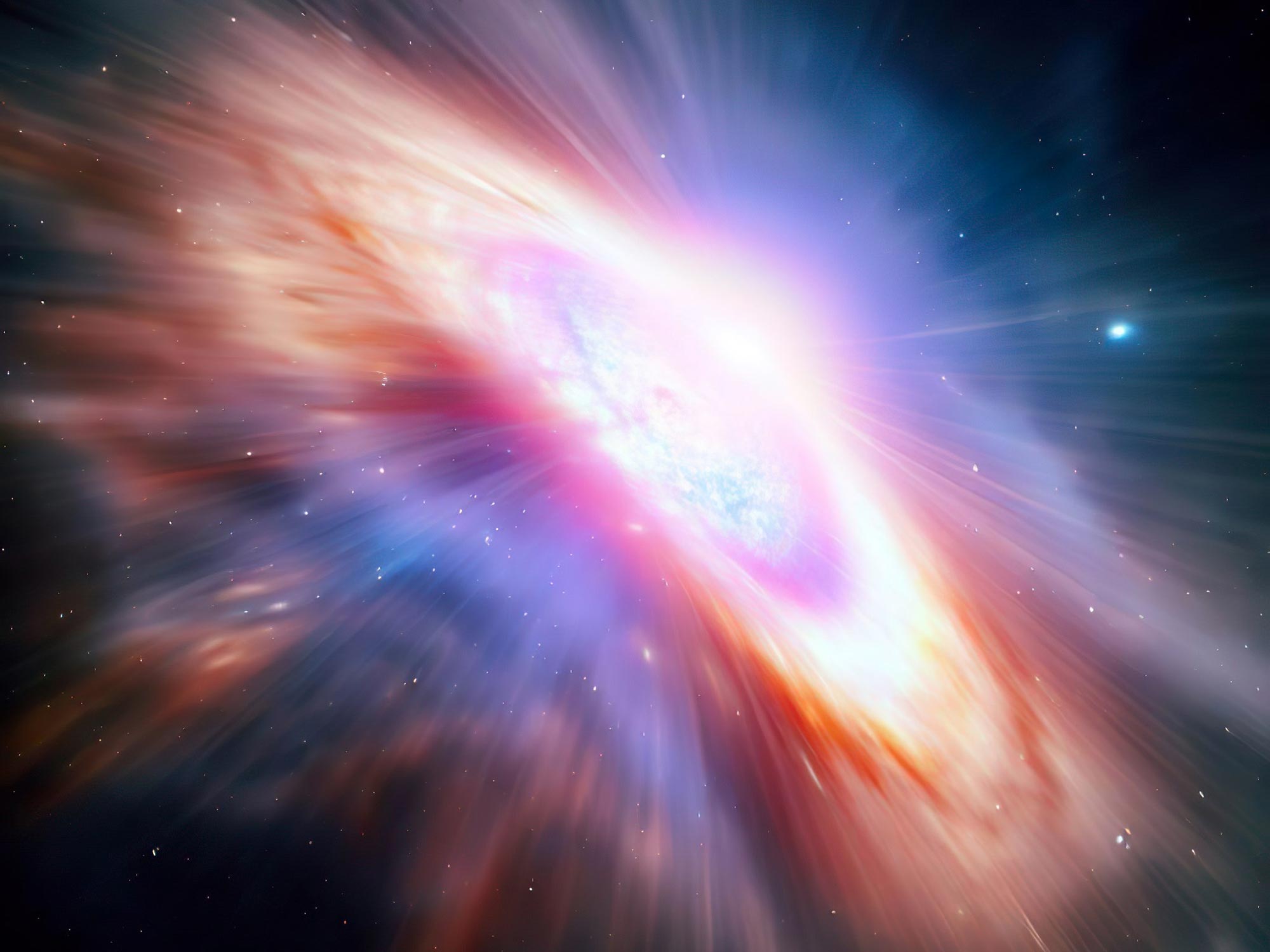
Primordial black holes may trigger some white dwarf explosions and leave measurable signatures in the Milky Way’s chemistry.
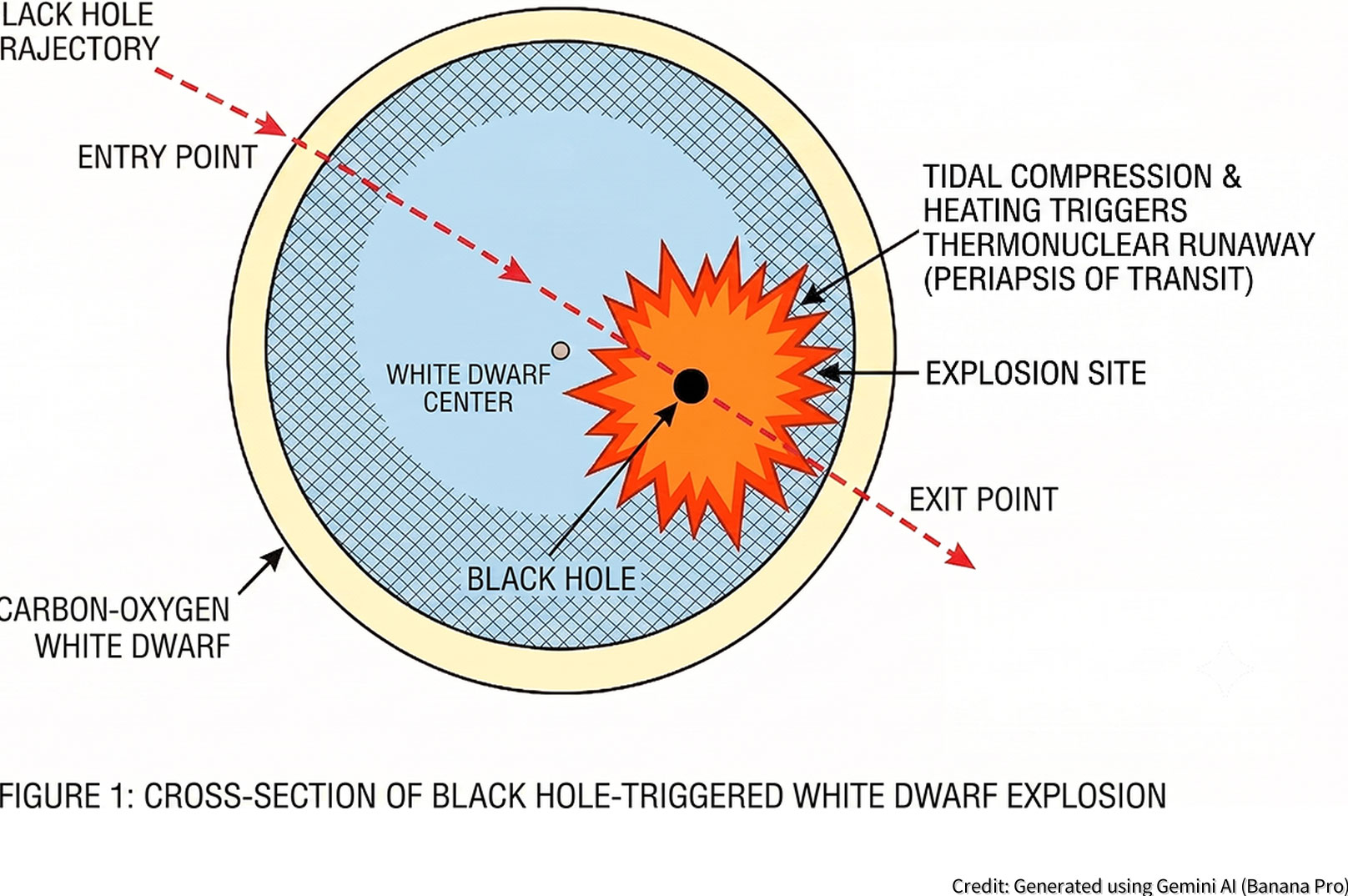
Some Type Ia supernovae may begin with an invisible intruder passing through a white dwarf. An international research team has found that primordial black holes could trigger these stellar explosions and leave behind chemical patterns observed in the Milky Way. The study was published in The Astrophysical Journal.
Primordial black holes (PBH) are hypothetical remnants of the early universe that may have formed from fluctuations in matter during cosmic inflation. They are also considered possible candidates for dark matter, the unseen material that accounts for about 90% of matter in the Universe by mass.
As PBHs travel through space, some could pass through stars. Previous research has suggested that the intense tidal forces created by a PBH’s gravity during such an encounter might ignite a white dwarf, the compact remnant left by a low-mass star, and cause it to explode as a Type Ia supernova (SNe Ia).
Hidden black holes could ignite stars
Shing-Chi Leung, an assistant professor at SUNY Polytechnic Institute and visiting associate scientist at The University of Tokyo’s Kavli Institute for the Physics and Mathematics of the Universe (Kavli IPMU), led the research. The study also included Kavli IPMU Visiting Senior Scientist Ken’ichi Nomoto and Kavli IPMU Senior Fellow Alexander Kusenko.
The researchers examined the motion, light, and chemical signatures expected from supernovae produced through this proposed PBH-triggered pathway.
In an earlier study published in 2025, the group showed that explosions initiated by primordial black holes could produce SNe Ia that closely resemble those generated by standard Type Ia supernova models.
Observations match the proposed explosions
For the latest work, the researchers compared their models with the supernova remnants Tycho, Kepler, and 3C 397, as well as nearby explosions including SN 2011fe and SN 2012cg. They also examined chemical abundance patterns in stars throughout the Milky Way.
The results showed that PBH-triggered SNe Ia could reproduce several observed properties of these objects. By studying radioactive isotopes such as Ni-56 and Ni-57, together with stable elements including Mn and Ni, the researchers constrained the masses and metallicities (the amount of heavier elements present when a star formed, which provides clues to its age in cosmic history) of the stars that produced the explosions and remnants.
The researchers also modeled how this proposed explosion pathway could contribute to the chemical enrichment of the galaxy. Their results indicated that a non-zero fraction of Type Ia supernovae triggered by primordial black holes is needed to explain a chemical abundance trend observed among Milky Way stars.
“Our work suggests that some supernovae that we observe in the sky could be a result of PBHs. Therefore, even though we cannot directly observe these evasive entities, they leave many interesting clues in nature for us to probe their properties.” Leung said.
The researchers plan to broaden their investigation by examining how PBH-triggered explosions would affect the overall population of conventional supernovae and the combined rates of these short-lived astronomical events.
Reference: “Primordial Black Hole Triggered Type Ia Supernovae. II. Comparison with Supernova Remnants and Galactic Chemical Evolution” by Shing-Chi Leung, Seth Walther, Alexander Kusenko, Ken’ichi Nomoto and Tomoharu Suzuki, 15 June 2026, The Astrophysical Journal.
DOI: 10.3847/1538-4357/ae6db7
This material is based upon work supported by the National Science Foundation under Grant AST-2316807.
Never miss a breakthrough: Join the SciTechDaily newsletter.
Follow us on Google and Google News.
Full article can be found at: https://scitechdaily.com/invisible-black-holes-could-be-triggering-supernovae/


