



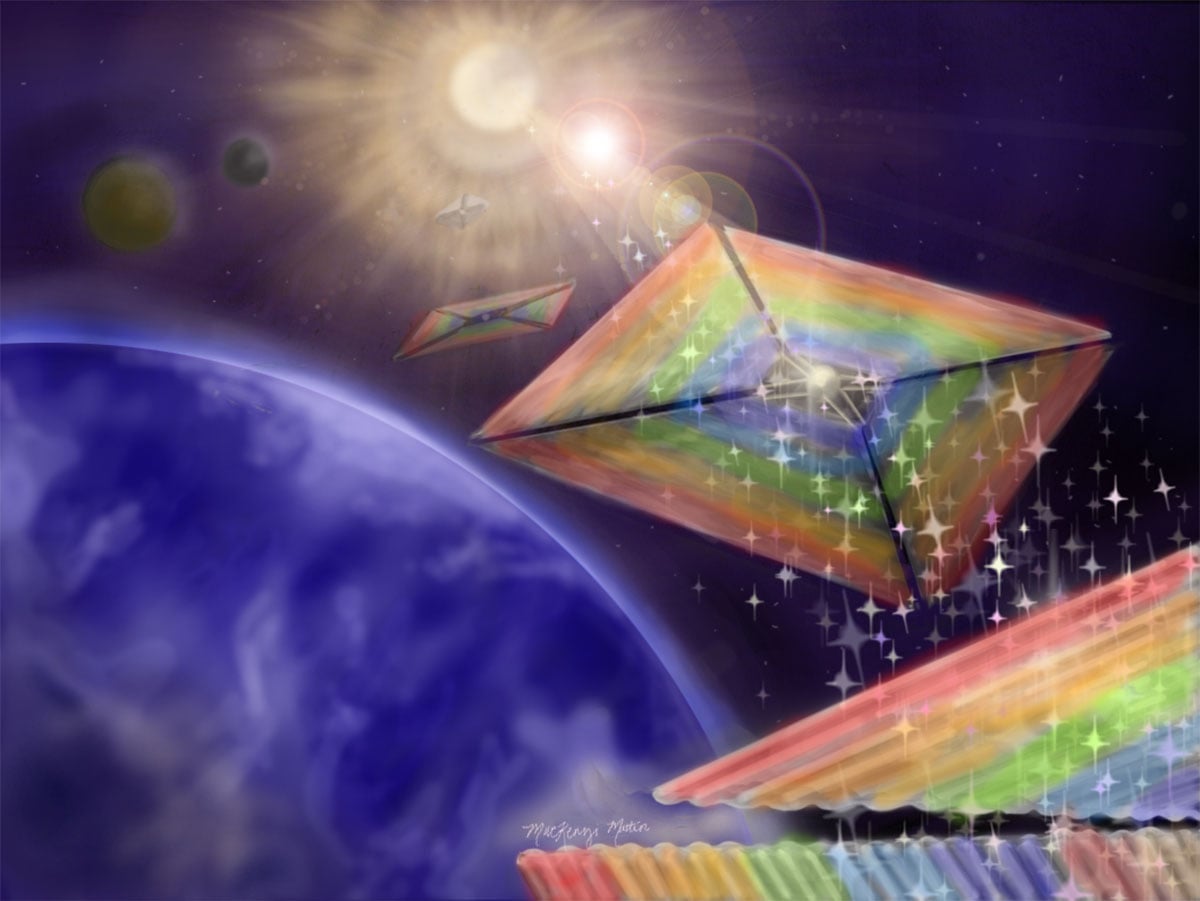
Solar sails may encounter drag from light itself as they approach a significant fraction of the speed.
Getting a spacecraft to another star is not simply a matter of building a bigger rocket. Chemical propulsion is far too slow for interstellar travel on practical timescales, which is why many mission concepts turn to light itself as the engine.
One of the leading ideas is a solar sail, a vast reflective sheet pushed by photons. In more ambitious interstellar designs, the sail would be driven not just by sunlight, but by powerful lasers that could accelerate it to speeds far beyond what conventional spacecraft can reach.
A new paper available on arXiv by Chao Shen and Jiaze Li of the Harbin Institute of Technology points to a strange complication. At a large fraction of the speed of light, the same light that pushes a sail forward may begin to work against it.
Photons push in several ways
The paper examines three ways that photons transfer force to a solar sail. The first is incident light, which comes from the direct momentum of photons striking the sail. The second is specular reflection, which occurs when photons bounce cleanly off the reflective surface and transfer additional momentum. The third is diffuse scattering, which happens when photons are absorbed and then reemitted in random directions.
Under ordinary conditions, these effects help propel the sail. But the picture changes once the craft begins moving at relativistic speeds, where the rules of motion must account for effects that become important near the speed of light.
As the sail races away from its laser source, the light reaching it is shifted by the Doppler effect. The frequency drops, and with it the thrust generated by each of the three photon-driven forces. That means the faster the sail travels, the harder it becomes to keep accelerating it efficiently.
Light itself becomes drag
It gets even worse when the light sail hits 75% of the speed of light. At that point, a phenomenon called relativistic light aberration takes over. From the perspective of a stationary observer on Earth, the diffusely scattered light is directed forward towards the sail’s direction of motion. Since every action must have an equal and opposite reaction, that means the diffuse scattering (admittedly the weakest of the three forces) becomes an active drag on the system past 75% of the speed of light.
Admittedly, the net force of the pushing laser remains positive at that point, but the efficiency drop-off is significant. It is worth noting that the paper focuses exclusively on radiative dynamics and does not account for non-radiative factors, such as drag from interstellar gas or dust, nor does it address thermal limitations of sail materials, such as potential melting under high-power lasers.
The paper treats the lightsail material as an idealized mirror. In practice, aerospace engineers are exploring advanced metamaterials and photonic crystals tuned to specific laser wavelengths. These materials could potentially leverage the aberration effects discussed in the paper to actively self-correct and stabilize the lightsail’s flight path, ensuring it remains centered in the beam.
Engineering must catch up
But we’re still a long way away from actively building and testing a fully fledged interstellar solar sail. When traveling that far there are even more complications, like the curvature of spacetime, which the paper also simplifies out.
But every step towards understanding the flight dynamics in such a system is a step in the right direction, because, when we eventually do decide to send a probe to another star, we’ll need all the engineering and understanding we can get.
Reference: “Relativistic Lightsail Propulsion Dynamics” by Chao Shen, Jiaze Li, 2 June 2026, arXiv.
DOI: 10.48550/arXiv.2606.04052
Adapted from an article originally published in UniverseToday.
Never miss a breakthrough: Join the SciTechDaily newsletter.
Follow us on Google and Google News.
Full article can be found at: https://scitechdaily.com/the-strange-force-that-could-slow-interstellar-solar-sails/


