



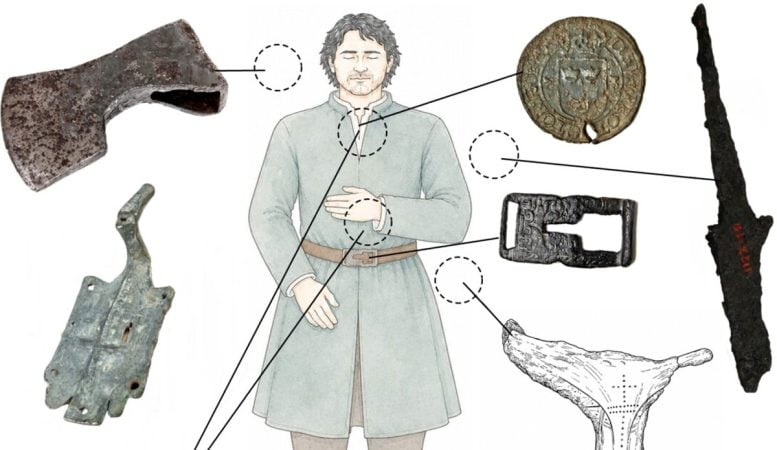
A multidisciplinary study has uncovered new details about a centuries-old burial in northern Finland, revealing genetic links to Sámi populations and evidence of a remarkably mobile life.
A new study by the University of Turku and its partners has revealed new details about a man buried near Lake Kitka in Kuusamo, Finland, around the turn of the 16th and 17th centuries. DNA and isotope analyses suggest he was closely related to present-day Sámi populations and arrived in the region only shortly before his death.
The research team analyzed DNA and isotopes from an individual whose grave was discovered near Lake Kitka in the 1970s. The findings provide a clearer picture of the life of a man who lived about four centuries ago.
DNA recovered from the teeth of the approximately 40-year-old man was compared with previously studied ancient and modern genomes. The analysis found that his genetic profile most closely matched both historical and present-day Sámi populations. He also shared small DNA segments with modern Finns, particularly people living in northern and northeastern Lapland, while showing weaker genetic connections to residents of the Kuusamo area and southern Finland.
“A similar pattern emerges when present-day Sámi are used in the comparison instead of the Kitka individual. This suggests that the results reflect broader historical interaction and admixture between Sámi and Finnish populations,” says researcher Sanni Peltola from the University of Turku.
Genetic Evidence Links Kitka Individual to Sámi Populations
Peltola emphasized that while ancient DNA can help researchers trace population history, it cannot be used to determine a person’s ethnicity or identity.
“Sámi identity is not a biological trait, but a historical, cultural, and social phenomenon,” she notes.
The Kitka burial has also drawn significant interest from genetic genealogists. However, the researchers noted that DNA evidence cannot reliably link someone who lived so long ago to specific modern families or individuals.
DNA Findings Offer Insights but Not Identity
Isotope analysis of the man’s teeth suggests he arrived in Kuusamo only a short time before his death. During childhood, his diet included land animals, freshwater fish, and marine foods. Later in life, marine resources became more important, while freshwater fish, a key food source in the Kuusamo region, disappeared from his diet. Isotope signatures related to drinking water also indicate that he spent his teenage years in an area with geological characteristics very different from those found in Finland.
“The most likely location is a region with volcanic bedrock in the North Atlantic, likely Iceland. This interpretation is supported by historical evidence of contacts between Northern Fennoscandia and the North Atlantic during the 16th century,” says Senior Researcher Ulla Nordfors from the University of Turku.
Previous research suggested the Kitka individual may have been a noaidi, a Sámi ritual specialist. While the new study does not dismiss that possibility, it indicates that his life story was likely more complex than earlier interpretations suggested.
“The results show that historical Sámi communities and their social roles do not correspond to the images presented in older research literature,” Nordfors notes.
Reference: “Bioarchaeological analysis illustrates the life of a 16th-century Sámi individual from Kitka, Kuusamo, northern Finland” by Sanni Peltola, Ulla Nordfors, Laura Arppe, Markku Oinonen, Mika Sarkkinen, Miikka Voutilainen, Kerttu Majander, Thiseas C. Lamnidis, Luca Traverso, Johannes Krause, Antti Sajantila, Elina Salmela, Päivi Onkamo and Jussi-Pekka Taavitsainen, 25 May 2026, BMC Genomics.
DOI: 10.1186/s12864-026-12962-x
Never miss a breakthrough: Join the SciTechDaily newsletter.
Follow us on Google and Google News.
Full article can be found at: https://scitechdaily.com/scientists-uncover-surprising-secrets-of-a-mysterious-man-buried-in-finland-400-years-ago/


