



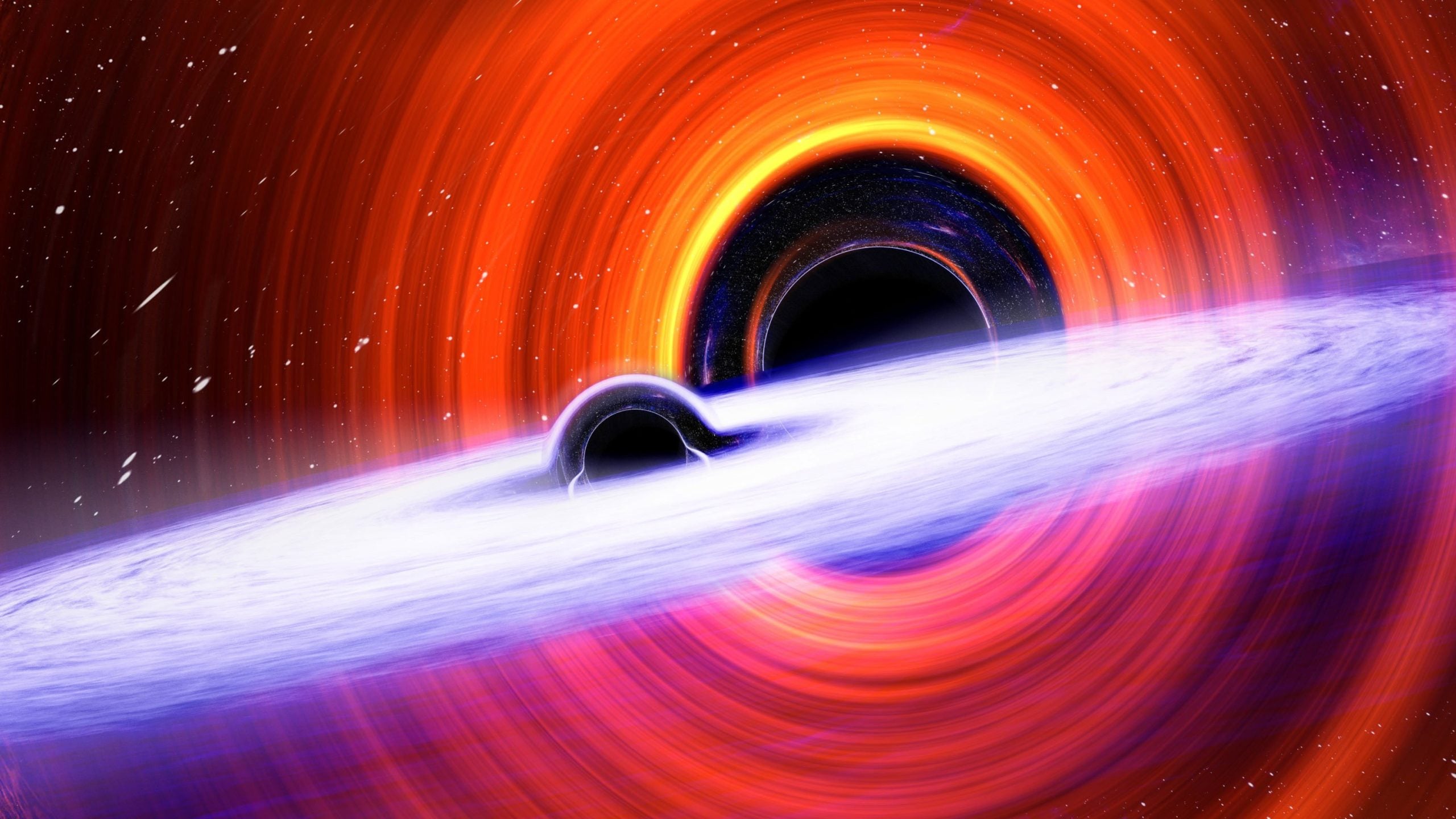
Scientists believe an unusual LIGO detection may be evidence of a primordial black hole, potentially linking these long-theorized objects to the mystery of dark matter.
Scientists at the University of Miami believe they may be closing in on evidence for one of the most elusive objects in the universe: primordial black holes. While definitive proof could still take years, their work may help confirm both the existence of these ancient objects and their possible connection to one of cosmology’s biggest puzzles.
Primordial black holes are theoretical objects thought to have formed during the first moments after the Big Bang. Unlike black holes created by collapsing stars, they could span a wide range of sizes, from objects as small as asteroids to much larger masses.
If they exist, they may help explain dark matter, the invisible material that makes up about 85 percent of the universe’s matter and provides the gravitational force that helps hold galaxies together.
“We believe our study will aid in confirming that they actually do exist,” Nico Cappelluti, an associate professor in the College of Arts and Sciences’ Department of Physics, said of the research he and Ph.D. student Alberto Magaraggia have conducted.
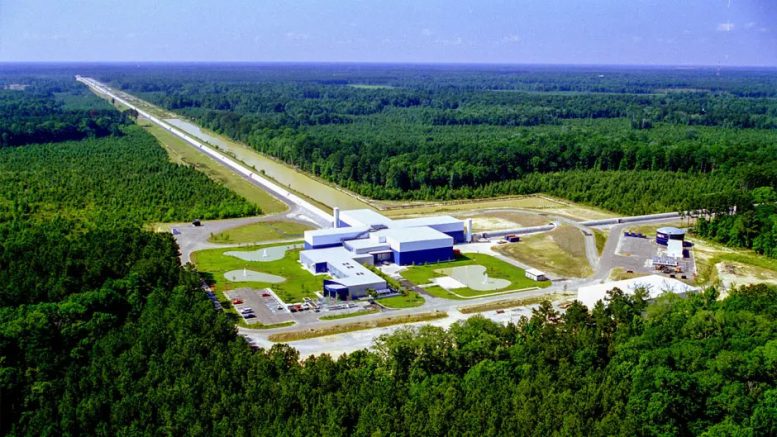
Their investigation was motivated by a recent possible discovery involving the Laser Interferometer Gravitational-Wave Observatory (LIGO). Late last year, LIGO detected an unusual gravitational wave signal. Gravitational waves are ripples in spacetime generated by powerful cosmic events such as black hole collisions.
LIGO’s Unusual Signal Sparks New Evidence
“The most common black holes form as the result of a supernova, the death of a massive star. So, their masses can range from a few times the Sun’s mass to billions of solar masses,” Cappelluti explained. But last November, LIGO issued an automated alert for a merger in which at least one of the objects weighed less than 1 solar mass, suggesting the potential of a primordial black hole.
Whether the signal represents a major scientific discovery or simply noise within LIGO’s detectors remains a subject of debate among astrophysicists.
Cappelluti and Magaraggia argue that the observation is best explained by a primordial black hole formed in the extremely dense conditions of the early universe, long before the first stars appeared. They believe their findings support that interpretation.
“We attempted to estimate how many primordial black holes may exist in the universe and how many of them LIGO should be able to detect,” Magaraggia said. “And our results are encouraging. We predict that subsolar black holes like the one LIGO may have observed should indeed be rare, consistent with how infrequently such events have been seen so far.”
Study Suggests Primordial Black Holes Make Up Dark Matter
According to the study, published in The Astrophysical Journal, “the most plausible explanation for the LIGO signal, which lacks any conventional astrophysical explanation, is the detection of a primordial black hole,” Cappelluti said. “And our research indicates that these primordial black holes could account for a significant portion, if not all, of dark matter.”
The researchers emphasize that much more analysis will be needed before firm conclusions can be drawn about the signal and its possible connection to dark matter.
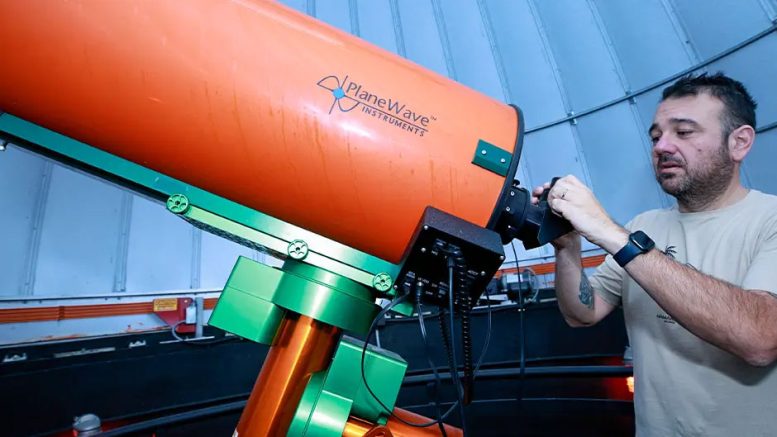
For now, confirmation depends on whether LIGO and its international partners detect similar events in the future. “LIGO picked up what is very strong evidence that these types of black holes exist. But we’ll need to detect another such signal or even several others to get the smoking-gun confirmation that they are real,” Cappelluti said. “But what is clear is that they cannot be excluded as being real.”
From Hawking’s Theory to Modern Gravitational Wave Astronomy
The idea of primordial black holes dates back to Soviet scientists Yakov Zeldovich and Igor Novikov, who first proposed them during the Cold War era. In the early 1970s, Stephen Hawking expanded on the concept, suggesting that large numbers of these objects could exist, emit radiation, and potentially explain dark matter.
LIGO later provided the first observational clues that could support these longstanding theories. On September 14, 2015, the observatory made the first direct detection of gravitational waves, opening a new chapter in astronomy and confirming a key prediction of Albert Einstein’s theory of general relativity.
LIGO consists of two facilities located in Hanford, Washington, and Livingston, Louisiana. Together with the Virgo detector in Italy and the underground KAGRA observatory in Japan, it forms the LVK collaboration. This network searches for black holes, regions of space where gravity is so intense that nothing, including light, can escape.
Next-Generation Observatories Will Test the Primordial Black Hole Theory
Planned upgrades will improve LIGO’s sensitivity and may allow it to detect more unusual signals. Even so, the observatory was not designed to observe gravitational waves directly from the Big Bang. Its two L-shaped detectors, each featuring vacuum arms measuring 2.5 miles (4 kilometers) in length, are optimized for detecting high-frequency waves produced by relatively recent violent cosmic events.
Future instruments will be able to probe much earlier periods of cosmic history, Cappelluti noted. The European Space Agency’s Laser Interferometer Space Antenna (LISA), scheduled for launch in 2035, is expected to detect gravitational waves originating from some of the earliest eras after the Big Bang.
Another project, Cosmic Explorer, is currently in the design stage. The U.S. ground-based observatory is expected to be 10 times more sensitive than LIGO, enabling it to detect black hole and neutron star mergers dating back to the era when the first stars formed.
Reference: “Implications for Primordial Black Hole Dark Matter from a Single Subsolar Mass Gravitational-wave Detection in LVK O1–O4” by Alberto Magaraggia and Nico Cappelluti, 27 March 2026, The Astrophysical Journal.
DOI: 10.3847/1538-4357/ae48f9
Never miss a breakthrough: Join the SciTechDaily newsletter.
Follow us on Google and Google News.
Full article can be found at: https://scitechdaily.com/mysterious-cosmic-signal-could-be-first-real-evidence-of-primordial-black-holes/


