



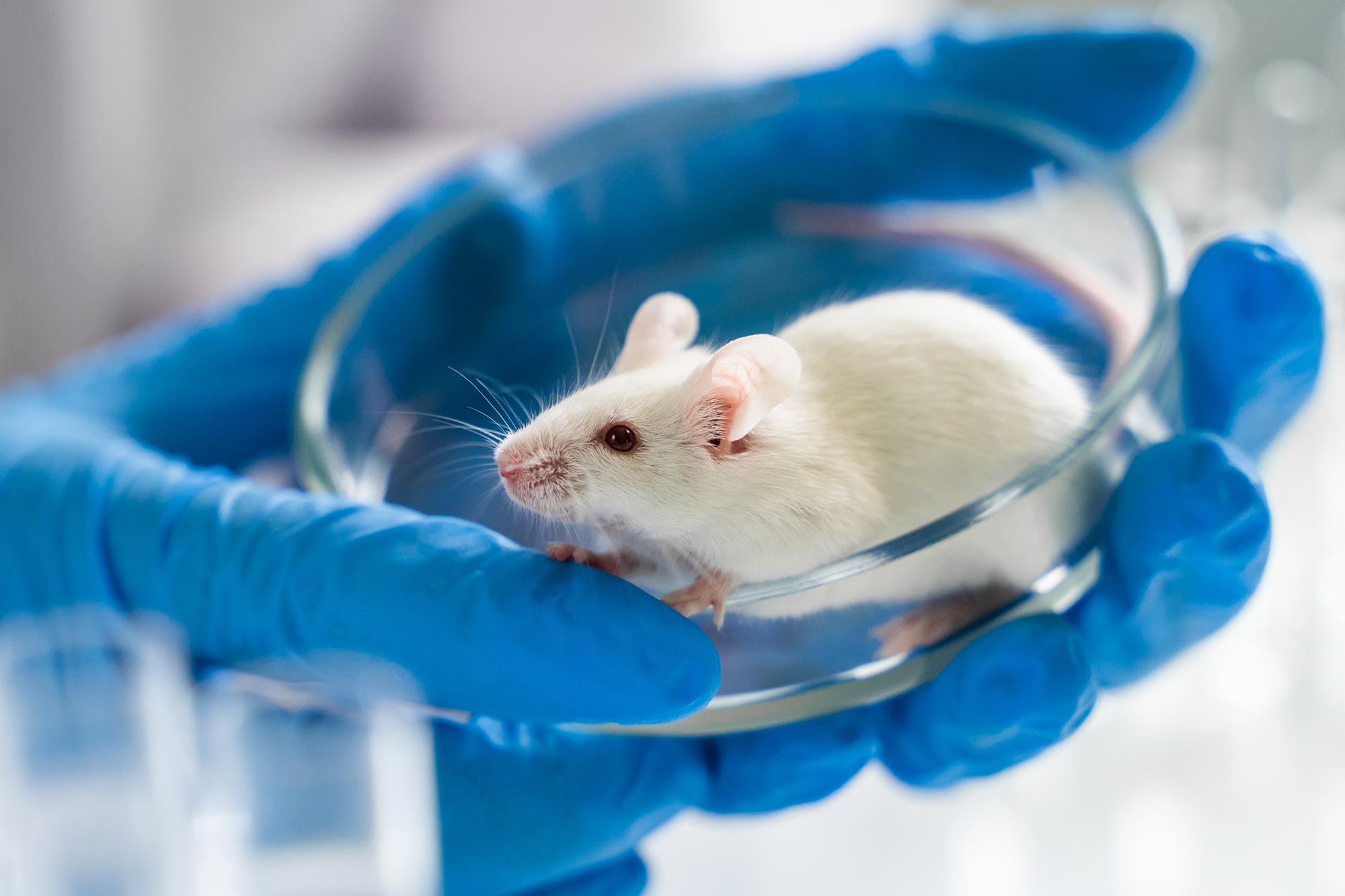
A new AI framework called MouseMapper allows scientists to examine disease-related changes across the entire body at cellular resolution.
Obesity does much more than affect metabolism and fat storage. It also changes immune activity, nerve structure, and tissue organization throughout the body, raising the risk of conditions such as type 2 diabetes, cardiovascular disease, stroke, neuropathy, and cancer. Despite these widespread effects, scientists have lacked tools capable of examining disease-related changes across an entire intact organism at high resolution.
Researchers led by Prof. Ali Ertürk, Director of the Institute for Biological Intelligence (iBIO) at Helmholtz Munich and Professor at LMU, have developed MouseMapper, a set of deep learning algorithms powered by foundation models that can analyze whole-body biological imaging data.
The system can automatically identify 31 organs and tissue types while mapping nerves and immune cells throughout the body, allowing scientists to study multiple organ systems in intact mice at the same time.
“MouseMapper is built on a foundation model, which means it generalizes far beyond the data it was originally trained on,” says Ying Chen, co-first author of the study.
MouseMapper Uses AI and Light-Sheet Microscopy
To generate whole-body maps, the scientists tagged nerves and immune cells in mice with fluorescent markers that could be detected under a microscope. They then applied tissue-clearing techniques that made the animals transparent without disrupting the fluorescent signals, allowing researchers to image deep within intact bodies.
The team used advanced light-sheet microscopy to generate detailed three-dimensional images of entire mice. The resulting datasets contained tens of millions of cellular structures across different organs and tissues. MouseMapper automatically analyzed the images, identifying nerves, immune-cell clusters, and anatomical regions throughout the body.
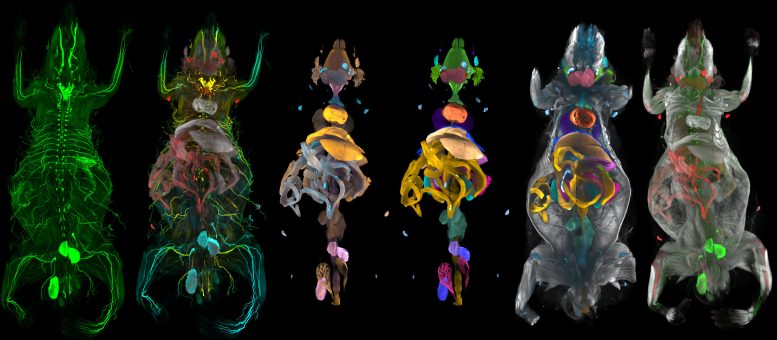
This approach enabled the researchers to pinpoint where inflammation and structural damage appeared in tissues, including fat, muscle, liver, and peripheral nerves, without having to choose specific regions in advance.
Obesity Damages Nerves and Alters Immune Activity
To study obesity-related changes, the scientists fed mice a high-fat diet that produced obesity and metabolic dysfunction similar to what is seen in humans. MouseMapper revealed widespread disruptions in immune-cell organization and nerve structure throughout the body.
One of the most significant discoveries involved the trigeminal nerve, a major facial nerve responsible for sensation and motor control. In obese mice, these sensory nerves showed far fewer branches and endings, suggesting impaired nerve function. Behavioral tests also showed that obese mice were less responsive to sensory stimulation than lean mice, connecting the structural damage to reduced sensory function.
The researchers then analyzed the trigeminal ganglion, which contains the cell bodies of facial sensory neurons. Using spatial proteomics, they identified molecular changes linked to nerve remodeling and inflammation. Many of the same molecular signatures were also found in trigeminal tissue from people with obesity, suggesting the nerve alterations seen in mice may also occur in humans.
Human Tissue Confirms Obesity-Linked Nerve Changes
“We revealed previously unknown structural and molecular changes in the trigeminal ganglion and its facial branches, and the same molecular signature was conserved in human tissue. This kind of finding simply cannot emerge from studying one organ at a time,” says Dr. Doris Kaltenecker, senior scientist at the Institute for Diabetes and Cancer (IDC) at Helmholtz Munich and first author of the study.
Beyond obesity, the researchers believe MouseMapper could improve the study of complex diseases that affect multiple organ systems, including diabetes, cancer, neurodegenerative diseases, and autoimmune disorders. Unlike earlier methods that focused on selected tissues or organs, MouseMapper offers an integrated whole-body analysis platform capable of locating disease “hotspots” throughout the organism.
The team has also made the whole-body datasets publicly available online, allowing researchers around the world to investigate obesity-related changes across tissues and organ systems.
“Our goal is to create a comprehensive framework for understanding how diseases affect the body as an interconnected system,” says Ali Ertürk. “Our long-term vision is to build truly realistic digital twins of mice in health and disease: cell-level atlases that we can query, perturb, and screen in silico computationally. That would let us pinpoint the earliest changes a disease causes, design interventions to prevent them, and accelerate the discovery of new treatments while reducing the number of physical experiments we need to run.”
Reference: “A deep-learning framework reveals whole-body perturbations at cell level” by Doris Kaltenecker, Izabela Horvath, Rami Al-Maskari, Ying Chen, Zeynep Ilgin Kolabas, Luciano Hoeher, Mihail Todorov, David-Paul Minde, Saketh Kapoor, Sena Gül Turhan, Louis B. Kuemmerle, Hanno Steinke, Tim Wohlgemuth, Mayar Ali, Florian Kofler, Pauline Morigny, Julia Geppert, Denise Jeridi, Bastian Wittmann, Jie Luo, Suprosanna Shit, Carolina Cigankova, Victor Miro Kolenic, Nilsu Gür, Eren Aydeniz, Alara Yücecan, Melissa Ertürk, Laurent H. A. Simons, Chenchen Pan, Marie Piraud, Daniel Rueckert, Maria Rohm, Farida Hellal, Markus Elsner, Harsharan Singh Bhatia, Ingo Bechmann, Bjoern H. Menze, Stephan Herzig, Johannes Christian Paetzold, Mauricio Berriel Diaz and Ali Ertürk, 20 May 2026, Nature.
DOI: 10.1038/s41586-026-10535-2
The work was supported by the European Research Council (Consolidator Grant CALVARIA to A. Ertürk; grant 949017 to M. Rohm), the German Research Foundation (DFG) under Germany’s Excellence Strategy within the Munich Cluster for Systems Neurology (SyNergy, ID 390857198, EXC 2145), DFG SFB 1052 (A9) and TR 296 (P03), the Collaborative Research Centre CRC 1744, the German Federal Ministry of Education and Research (NATON collaboration, 01KX2121, and HIVacToGC), the Vascular Dementia Research Foundation, the Nomis Heart Atlas Project Grant (Nomis Foundation), the Else-Kröner-Fresenius-Stiftung, the Edith-Haberland-Wagner Stiftung, the Helmut Horten Foundation, the EFSD and Novo Nordisk A/S Programme for Diabetes Research in Europe (to D. Kaltenecker), and the China Scholarship Council (to Y. Chen).
Never miss a breakthrough: Join the SciTechDaily newsletter.
Follow us on Google and Google News.
Full article can be found at: https://scitechdaily.com/scientists-turn-mice-transparent-to-uncover-obesitys-secret-effects-on-nerves/


