



An Iliad fragment discovered inside an Egyptian mummy shows how Homer’s influence extended across Roman culture, from imperial identity and education to everyday life in Roman Egypt.
Archaeologists have found something unexpected inside a 1,600-year-old Roman-era Egyptian mummy: a fragment of Homer’s Iliad. It wasn’t placed beside the body but inside the mummy’s abdomen. But the real surprise isn’t just where the fragment was found. It’s how it got there. To understand, we must go back—to the Iliad itself and to what it became in the Roman world.
In The Iliad, a poem shaped in the 8th century BC and attributed to Homer, the Trojan War does not end in triumph or renewal. It ends in devastation. The poem closes at the edge of collapse, with Troy reduced to a landscape of heroic ruin. And yet, this is not where the story ends.
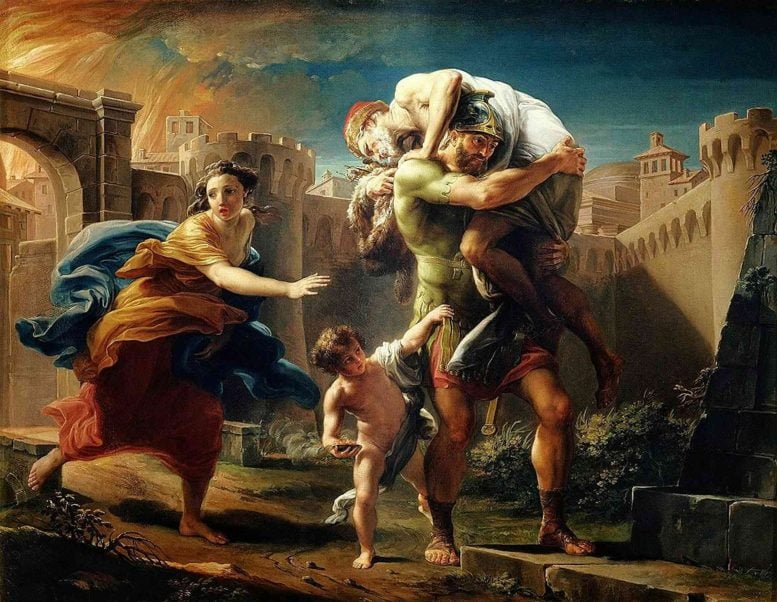
According to later Roman tradition, one Trojan escaped. Aeneas—son of Anchises and the goddess Aphrodite—fled the burning city carrying his father on his shoulders and the household gods in his hands. He moved west, across the Mediterranean, towards Italy, where he became the ancestor of Rome.
This continuation did not come from the Iliad itself. It was shaped centuries later, most famously in Virgil’s Aeneid. But it changed the meaning of the Trojan War entirely. The past, in other words, was actively reorganized—through stories that could be reworked, extended, and connected across time and space.
How Rome Reimagined the Trojan War
For Roman audiences, the Trojan War was more than a distant Greek legend. It became a way of thinking about origins, identity, and power.
Claiming descent from Troy was more than a matter of tracing a lineage. It required constant cultural work—through storytelling, education, and shared knowledge. The Iliad provided the raw material: characters, events, and genealogies that could be reshaped and redeployed across generations.
Across the Roman Empire, educated elites learned Homer as part of their schooling. They quoted him in speeches, analyzed him in classrooms, and used him to signal cultural authority. To know the Iliad was to speak a language that others across the empire understood.
A senator in Rome, a teacher in Asia Minor, or a student in Egypt could all draw on the same stories. The poem created a shared frame of reference—one that allowed very different people to situate themselves within a common past.
Homer as a Shared Language of Empire
In the Roman imperial period, the site of ancient Troy—located in modern-day Turkey—became a destination. Emperors invested in its development, tying it directly to Rome’s claimed Trojan origins. Under Emperor Augustus, Troy was folded into the political language of empire. And under Emperor Hadrian, it became part of a wider culture of travel, memory, and heritage.
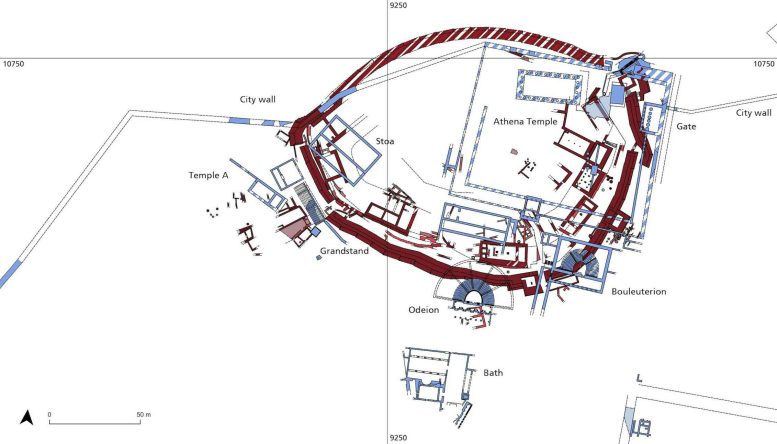
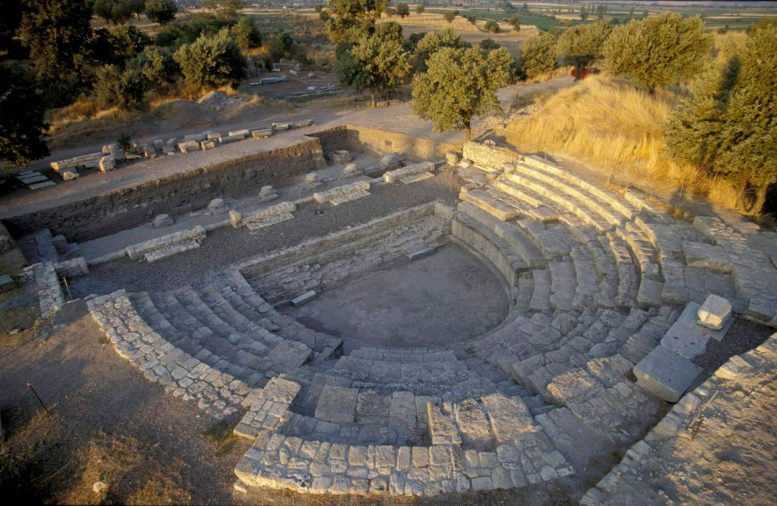
A visitor to Troy in the 2nd century AD would have arrived at a curated landscape. There were baths, places to stay, and spaces for performance. A small theater—the Odeion—was built directly into the ancient citadel so that the remains of the Bronze Age city, understood as the setting of the legendary battles around Troy, formed a dramatic backdrop.
Visitors could walk through what was presented as the setting of a Homeric epic, experiencing the Trojan War as something anchored in the ground beneath their feet.
Troy as a Roman Heritage Destination
Across the Roman Empire, the Iliad circulated as a living text: copied, taught, and read. Egypt, one of Rome’s most important provinces, was no exception. Yet here, Homer circulated within a cultural landscape that differed in important ways from the Greek literary world in which the poem had first taken shape.
For Roman observers, Egypt often appeared as a place where antiquity was materially preserved as well as remembered—through temples, monuments, and practices that emphasized continuity with the past. At the same time, it was a deeply hybrid society, where Egyptian, Greek, and Roman traditions interacted in complex ways.
Homer was among the most widely copied authors in Roman Egypt—read and taught as a marker of education and cultural belonging and deeply embedded in everyday literary culture.
The Homeric version of the Trojan War was particularly prominent among the Greek-speaking elite, especially in urban centers such as Oxyrhynchus, where the mummy was found. Other versions of the story—which placed greater emphasis on Paris and Helen’s stay in Egypt, as reported by Herodotus based on accounts from Egyptian priests—were probably more widespread among the broader Egyptian population.
Homer’s Influence in Roman Egypt
The initial media coverage of the discovery of the fragment inside the Egyptian mummy suggested the text was deliberately chosen to accompany the deceased. As a personally meaningful object, perhaps reflecting their education or cultural identity.
The most telling explanation, however, may be the most straightforward. Discarded or damaged papyri could be reused as inexpensive material. The fragment may therefore have functioned as stuffing–bundled together and inserted into the body cavity without particular regard for its literary content.
The very fact that a scrap of the Iliad could end up as disposable filling, however, speaks to how deeply Homer had penetrated everyday life in Roman Egypt.
Why an Iliad Fragment Ended Up Inside a Mummy
To make sense of the past in the Roman world meant moving between story and monument, between genealogy and deep time. Each perspective made the others more intelligible.
The Iliad helped create a world in which different pasts could be connected, compared, and reshaped. By linking stories, places, and traditions across the Mediterranean, the Roman world turned the past into a flexible resource—one that could generate identity, authority, and belonging in shifting contexts.
This is why the Iliad mattered: it circulated across many different settings. It shaped elite education, but it was also part of everyday reading culture. At Troy, it helped transform the city into a place of cultural memory. The text itself also had a long material afterlife, surviving not only as an authoritative story but also through manuscripts and writing materials that were copied, passed on, or even reused for entirely different purposes.
Its most enduring insight is therefore this: the past is not something simply preserved, but something continuously made and remade—through the stories, practices, and materials that carry it across time.
Adapted from an article originally published in The Conversation.
Never miss a breakthrough: Join the SciTechDaily newsletter.
Follow us on Google and Google News.
Full article can be found at: https://scitechdaily.com/archaeologists-have-found-something-unexpected-inside-a-1600-year-old-egyptian-mummy/


