



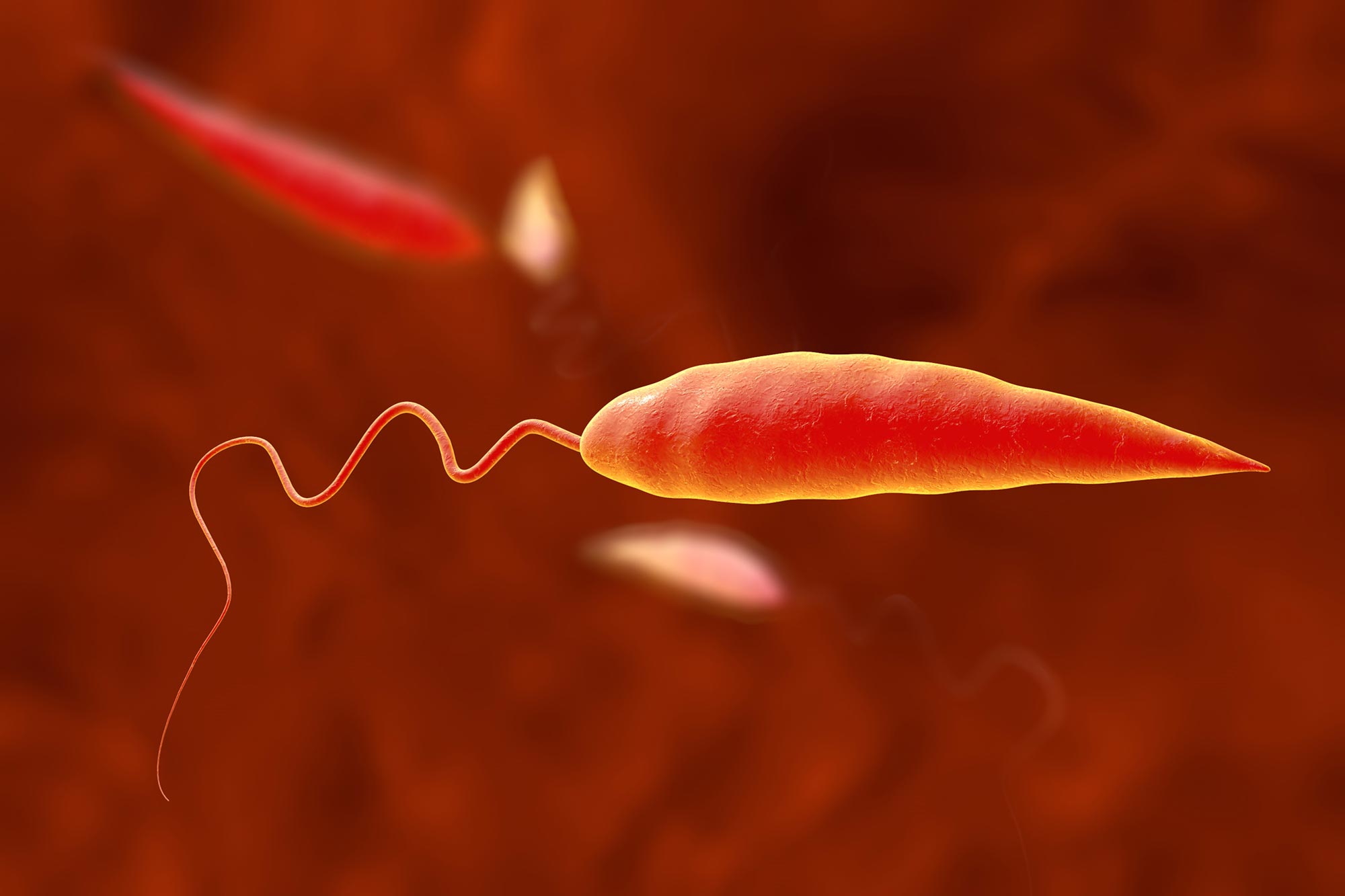
Leishmania parasites appear to evolve through widespread genetic exchange, reshaping assumptions about how they adapt and spread.
A parasite long thought to spread mostly by cloning itself may be far more genetically dynamic than scientists once believed.
A new international study suggests that Leishmania—a group of microscopic parasites responsible for debilitating tropical diseases—regularly swaps genetic material through hybridization. The finding challenges a long-standing view of how these parasites evolve and could reshape how researchers think about their ability to spread, adapt, and potentially develop drug resistance.
Mississippi State University biologist Matthew W. Brown contributed to the study, which was published in the Proceedings of the National Academy of Sciences. The research focused on Leishmania, a genus of protistan parasites in the trypanosomatid group that are transmitted through insect bites and occur in many parts of the world.
Diseases caused by Leishmania parasites, collectively known as leishmaniasis, can range from skin ulcers to severe infections that affect internal organs. Because the parasites circulate across diverse regions and hosts, understanding how they evolve is essential for tracking disease spread and designing better prevention and treatment strategies.
Brown, the Donald L. Hall Professor of Biology in MSU’s Department of Biological Sciences, helped with the genetic analysis and the interpretation of evolutionary patterns.
“Understanding how these parasites exchange genetic material fundamentally changes how we think about their evolution and adaptability,” Brown said. “This work shows these parasitic organisms readily exchange genetic material—it’s actually a dominant force shaping these organisms, with real implications for disease dynamics and control strategies worldwide.”
Genetic exchange drives adaptation
The study pushes back against the long-held view that Leishmania populations spread mainly through clonal, or asexual, reproduction. Instead, the researchers found that genetic exchange appears to be widespread across major human-infective species.
To investigate the scale of that exchange, the team developed a pan-genus multilocus typing method using 27 genetic markers and applied it to 254 “Old World” Leishmania isolates assigned to 11 species. These isolates came from broadly distributed populations, allowing the researchers to compare genetic patterns across species and geographic regions.
Their analysis revealed high levels of heterozygosity and allelic diversity, signs that the parasites’ genomes were not simply being copied from one generation to the next. Approximately 72% of the isolates showed evidence of genetic hybridization, including both interspecific hybridization between different species and intraspecific hybridization within the same species.
The researchers also conducted whole-genome sequencing on 24 isolates, which validated the broader hybridization patterns detected through the multilocus analysis.
Those findings suggest that many Leishmania parasites have mosaic ancestry, with blocks of genetic material inherited from distinct parental lineages. In other words, their evolutionary history looks less like a simple branching tree and more like a tangled network of genetic exchange.

The new publication connects to Brown’s broader research on how complex organisms arose from microbial ancestors.
Last fall, Brown also took part in another international project that led to a major discovery published in Nature. That team identified a new organism, Solarion arienae, and established both a new phylum and a previously unknown eukaryotic supergroup. The finding added new detail to scientists’ understanding of the earliest stages in the evolution of complex life on Earth.
Brown was named the 2025 recipient of MSU’s Ralph E. Powe Research Excellence Award in recognition of his research contributions. The award is the university’s highest honor for research achievement.
Brown is a leading evolutionary biologist who has written more than 70 peer-reviewed publications, received nearly 10,000 citations, and secured about $4 million in research funding. He also recently received an $870,000 collaborative grant from the Gordon and Betty Moore Foundation to expand a widely used software suite for creating large-scale evolutionary datasets.
Reference: “Extensive heterozygosity and genetic exchange among natural populations of Leishmania species” by Eliza V. C. Alves-Ferreira, Mourad Barhoumi, Tiago R. Ferreira, Matthew W. Brown, Petr Volf, Yusr Saadi-BenAoun, Immen Khammari, Ihcen Kherachi, Akila Fathallah Mili, Zoubir Harrat, Ikram Guizani, David L. Sacks, Julius Lukeš and Michael E. Grigg, 17 April 2026, Proceedings of the National Academy of Sciences.
DOI: 10.1073/pnas.2537999123
Never miss a breakthrough: Join the SciTechDaily newsletter.
Follow us on Google and Google News.
Full article can be found at: https://scitechdaily.com/scientists-have-discovered-these-deadly-parasites-are-secretly-swapping-dna/


