



A new evolutionary analysis suggests that modern blood and immune cells may preserve a 700-million-year legacy inherited from ancient single-celled ancestors.
Long before humans, dinosaurs, or even fish existed, ancient single-celled organisms may have already carried the genetic blueprint for one of the body’s most important systems: blood.
A new study from Kyoto University suggests the origins of blood cells stretch back roughly 700 million years, to a time when the first multicellular animals were only beginning to emerge. By tracing the evolutionary history of immune and blood cells across species, researchers found evidence that parts of the human immune system may have been inherited from microscopic ancestors that lived long before complex life evolved.
Today, blood does far more than transport oxygen. Its cells hunt pathogens, repair damaged tissue, trigger inflammation, and coordinate immune defenses. But despite decades of research into how blood cells function, scientists have struggled to answer a more fundamental question: where did these cells come from in the first place?
To investigate, the research team developed a new method for comparing gene activity across different animal species and cell types. They then used those data to build evolutionary family trees that map how blood cell lineages may have emerged and diversified over hundreds of millions of years. Unlike many previous studies, the researchers also included unicellular organisms in their analysis, allowing them to search for genetic connections between modern blood cells and ancient single-celled life.
Clues From Ancient Genes
Among the human blood cell lineages examined, macrophages showed the strongest similarities to unicellular organisms. This suggests the earliest blood cells may have resembled macrophages.
The researchers also traced the gene FOS, which is widely expressed in blood cells across animal species, back to a single-celled ancestor that lived about 700 million years ago. Their findings suggest the first blood cells emerged around the same period that multicellular animals began to appear.
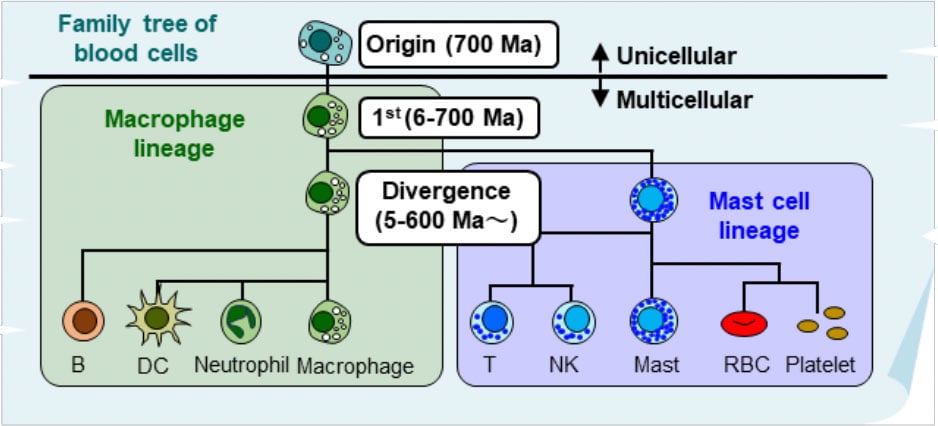
The study indicates that early animals may have formed the first blood cells by reusing genetic material inherited from single-celled ancestors. The analysis also suggests mast cells later diverged from macrophages, followed by the emergence of prototypic T cells and red blood cells from mast cells. Prototypic B cells appear to have branched from macrophages after mast cells separated.
A 700-Million-Year Biological Legacy
By reconstructing the evolutionary family tree of blood cells across 700 million years, the researchers found that traces of this ancient history remain embedded in the developmental pathways of modern blood cells. The study suggests that the blood and immune cells circulating in vertebrates today are part of a biological legacy passed down from single-celled ancestors.
“I feel deeply moved by these findings, which represent the culmination of our work and illustrate that the differentiation pathways of vertebrate blood cells reflect the 700-million-year evolutionary history of these cells,” says team leader Hiroshi Kawamoto.
“When I let it sink in that this legacy from so long ago is circulating within my body as blood cells, I feel closer to our distant ancestors,” adds first author Yosuke Nagahata of the Institute of Evolutionary Biology, Spain.
The researchers say the method developed for this study could also help scientists investigate the evolutionary origins of diseases such as cancer, potentially improving understanding of disease mechanisms and supporting the development of new treatments.
Reference: “Animals have expanded the evolutionary legacy of unicellular ancestors in blood cells” by Yosuke Nagahata, Yuji Nishimura, Ryota Kaitani, Jason Cheok Kuan Leong, Izumi Oda-Ishii, Hisanori Kohtsuka, Shinya Abe, Tasuku Ishida, Marina Carmona-Rivas, Sebastián R. Najle, Elena Casacuberta, Koichi Ikuta, Toru Miura, Michio Ogasawara, Naoki Irie, Yutaka Satou, Iñaki Ruiz-Trillo and Hiroshi Kawamoto, 28 May 2026, Proceedings of the National Academy of Sciences.
DOI: 10.1073/pnas.2528110123
Funding: Japan Society for the Promotion of Science, Kyoto University, European Regional Development Fund, Departament de Recerca i Universitats de la Generalitat de Catalunya
Never miss a breakthrough: Join the SciTechDaily newsletter.
Follow us on Google and Google News.
Full article can be found at: https://scitechdaily.com/your-blood-may-carry-a-700-million-year-old-secret/


