



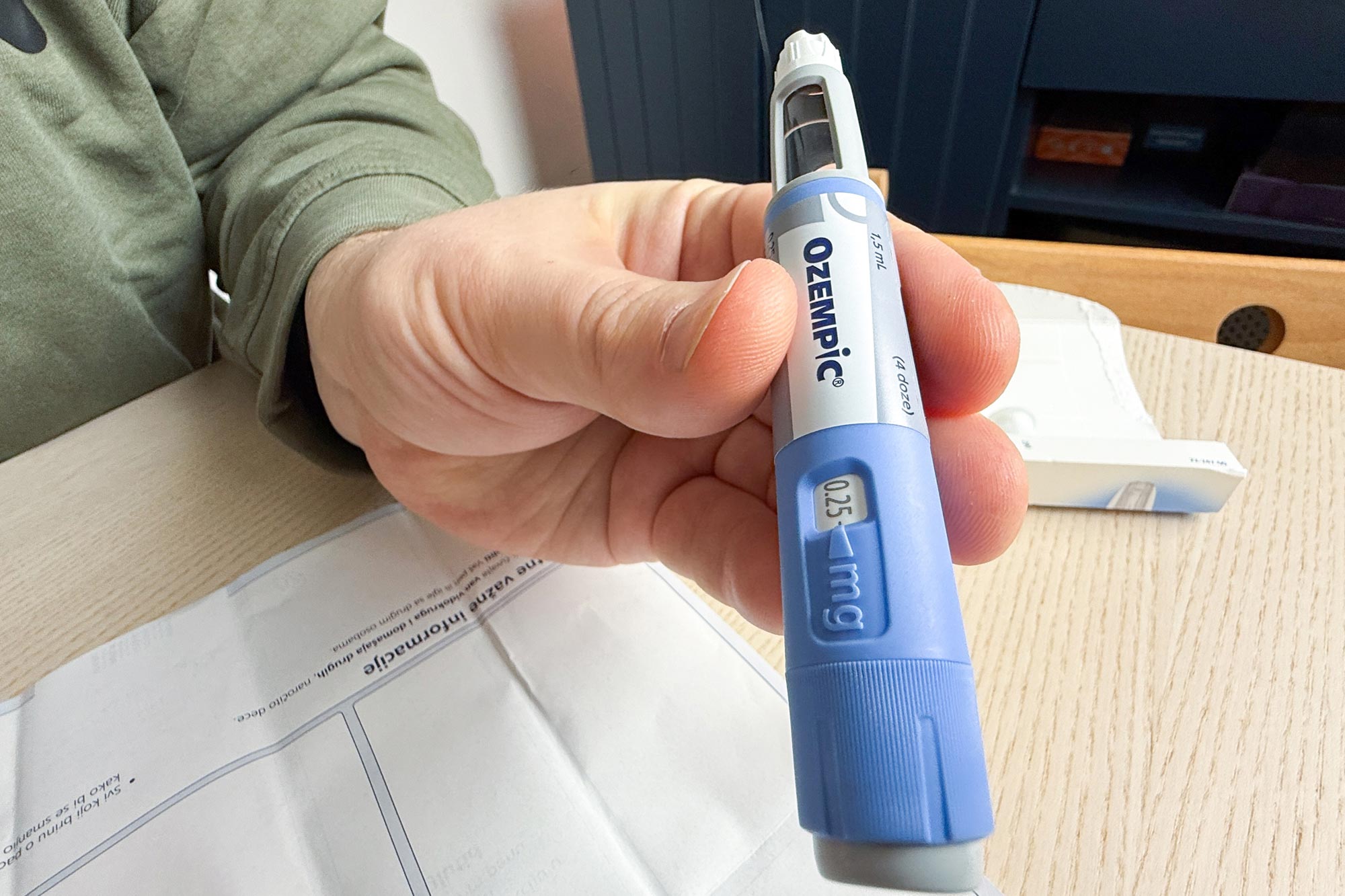
Scientists may have found the brain-cell switch that determines how long Ozempic’s weight-loss effects last.
Researchers at the National Institutes of Health (NIH) have gained new insight into how GLP-1 receptor agonists such as semaglutide produce their weight-loss effects. While scientists have long known which areas of the brain are involved, much less has been understood about what happens inside the individual neurons these medications target.
Using mice, the research team identified key signaling processes within brain cells that appear to play an important role in semaglutide-driven weight loss. The findings could help explain why some people respond better to GLP-1 medications than others and why weight loss often slows or stops after an initial period of success.
“We know much less about the nuts and bolts of what goes on within the neurons that these medications target. By digging into these mechanisms, we’re beginning to answer some of these questions,” said co-corresponding author Andrew Lutas, Ph.D., an investigator at NIH’s National Institute of Diabetes and Digestive and Kidney Diseases (NIDDK).
Looking Inside Brain Cells
To investigate what occurs inside neurons after semaglutide exposure, researchers led by first author Claire Gao, Ph.D., a postdoctoral fellow at NIH’s National Institute of General Medical Sciences (NIGMS), used a fluorescence imaging technique to observe living mouse brain tissue.
The team selectively blocked or removed specific signaling molecules within cells to determine which pathways were most important for the drug’s weight-loss effects.
Their experiments revealed that semaglutide’s impact depended on increasing levels of cyclic adenosine monophosphate (cAMP), a signaling molecule found within cells. This activity was observed in the area postrema, a region of the brain involved in appetite regulation.
However, the response was not identical across all neurons.
“It was not an all-or-nothing phenomenon. We observed that cAMP responses across cells varied on a continuum,” said co-corresponding author Michael Krashes, Ph.D., a senior investigator at NIDDK.
Why Some Neurons Respond Longer Than Others
The researchers found that some neurons maintained elevated cAMP levels for extended periods while semaglutide was present. Other neurons showed only short-lived increases.
According to the authors, this difference may occur because some cells internalize or break down their GLP-1 receptors, reducing the drug’s ability to continue signaling. To test whether they could prolong the response, the team blocked PDE4, a naturally occurring enzyme that breaks down cAMP, using the drug roflumilast.
Doing so shifted more neurons toward maintaining a sustained signaling response.
Potential Path to Longer-Lasting GLP-1 Effects
The findings suggest that extending cAMP activity could potentially lengthen the effects of GLP-1 medications. If future studies confirm this approach, it may one day reduce the frequency with which patients need to take these drugs.
Researchers also believe that manipulating cAMP signaling could eventually help address the weight loss plateaus that many people experience while using GLP-1 therapies. However, the authors emphasized that much more research is needed before those possibilities can be tested in patients.
One limitation of the current study is that the imaging methods allowed scientists to observe intracellular signaling for only a few hours. The team plans to use newer technologies in future studies to examine how GLP-1 drugs affect neurons over longer periods, including days and weeks.
Reference: “Semaglutide drives weight loss through cAMP-dependent mechanisms in GLP1R-expressing hindbrain neurons” by Claire Gao, Isabelle C. Geneve, Shakira Rodriguez-Gonzalez, Chia Li, Kaitlyn McElhern, Marc L. Reitman, Andrew Lutas and Michael J. Krashes, 22 May 2026, Nature Metabolism.
DOI: 10.1038/s42255-026-01534-8
Never miss a breakthrough: Join the SciTechDaily newsletter.
Follow us on Google and Google News.
Full article can be found at: https://scitechdaily.com/scientists-finally-uncover-why-ozempic-stops-working-for-some-people/