




An antisense therapy that targets a glycine transporter restored NMDA receptor function in mouse models related to autism and in human brain organoids.
An overlooked protein that regulates levels of the amino acid glycine may hold the key to treating autism and other disorders linked to disrupted brain signaling. Researchers at the Institute for Basic Science (IBS) have shown that inhibiting the glycine transporter SLC6A20 can restore the activity of NMDA receptors, a major target of neuroscience research for decades.
NMDA receptors play a central role in learning, memory, and communication between neurons. When their activity is reduced, the effects can contribute to conditions including autism spectrum disorder (ASD), schizophrenia, and intellectual disability. However, previous attempts to boost receptor activity have often been limited by side effects or insufficient effectiveness.
For the NMDA receptor to fully activate, it needs both glutamate and glycine. Earlier treatment strategies tried to raise glycine levels by blocking GlyT1, another glycine transporter. But GlyT1 is found widely in brainstem regions that help control breathing and movement, which often limited the benefits and caused unwanted side effects.
A more selective target
The researchers turned their attention to Slc6a20a, a glycine transporter found mainly in brain regions involved in cognition, including the cortex and hippocampus.
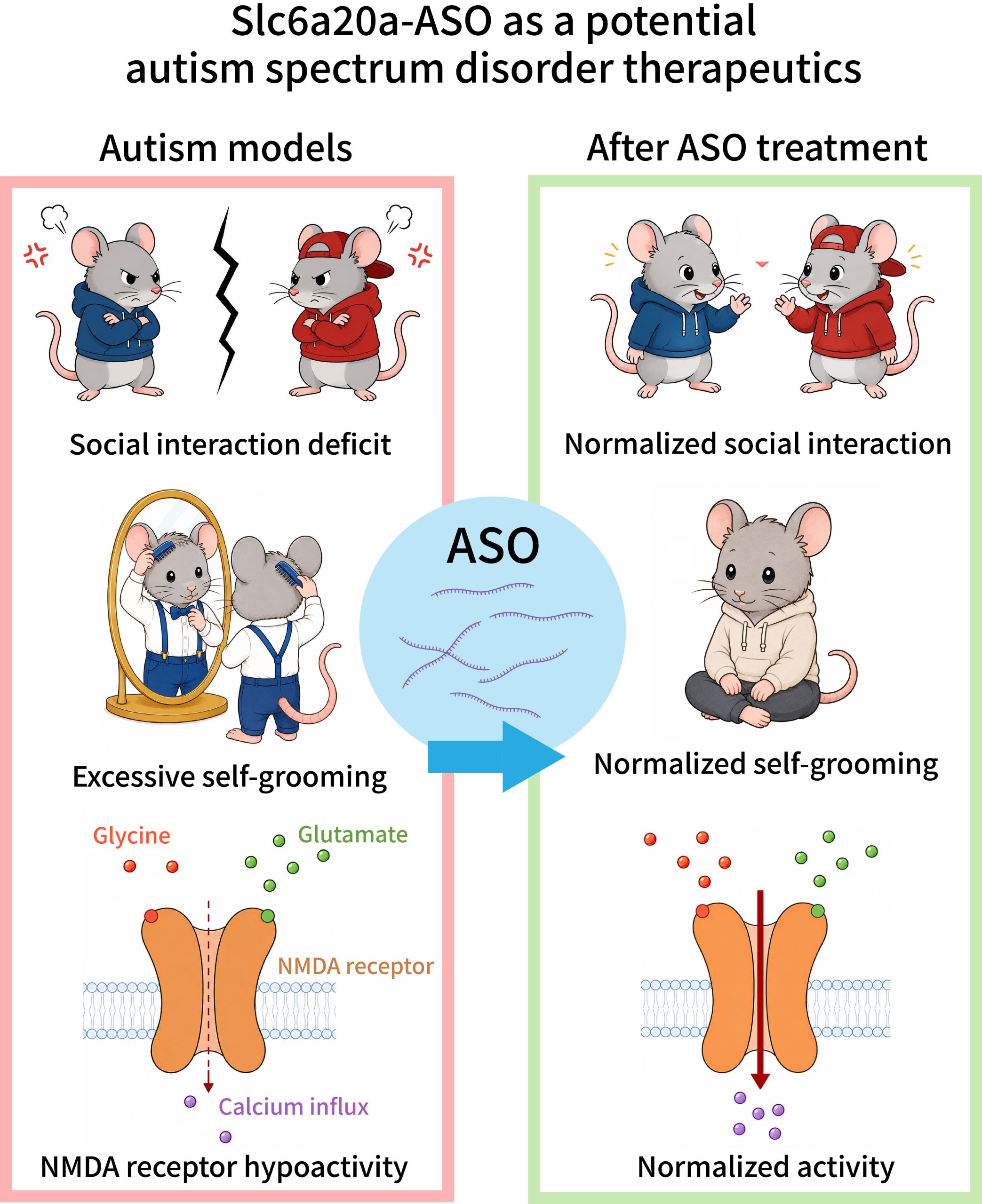
Using antisense oligonucleotides (ASOs) to reduce Slc6a20a expression, KIM Eunjoon and colleagues tested whether NMDAR function could be restored in mouse models with mutations in SHANK2 and SHANK3. These are two major autism risk genes that are also connected to Phelan McDermid syndrome and other neurodevelopmental disorders.
Mouse models regained function
The results showed that Slc6a20a ASO restored NMDAR activity across several autism related mouse models. The treatment also improved multiple behavioral abnormalities, including problems with social interaction, social communication, and repetitive behaviors. Notably, the benefits appeared in adult animals, suggesting that NMDAR dysfunction may still be correctable after major stages of brain development have already passed.
To examine how the treatment worked, the researchers carried out large-scale phosphoproteomic analyses. Unexpectedly, the therapy had only a limited effect on overall protein abundance. Instead, it corrected abnormal phosphorylation patterns in proteins involved in synaptic signaling and NMDA receptor regulation, suggesting that the approach improves protein function rather than simply changing protein levels.
Human organoids strengthened the case
To test whether the approach might translate to humans, the team expanded the research to human brain models.
Using CRISPR gene editing, the researchers created human cortical organoids with SHANK2 or SHANK3 mutations. These organoids showed reduced NMDAR activity, similar to what was seen in the mouse models. When treated with an ASO targeting the human SLC6A20 gene, NMDAR function returned to near normal levels.
“Unlike gene re-expression strategies, SLC6A20 inhibition works by modulating endogenous signaling pathways and may offer a more practical therapeutic route,” said Director KIM Eunjoon. “The fact that the effect was reproduced not only in mice but also in human cortical organoids suggests that this approach may represent a promising therapeutic strategy for neurodevelopmental disorders characterized by NMDA receptor hypofunction.”
Broader disorders may benefit
The researchers also reported that one ASO treatment remained effective for at least 8 weeks, with no detectable adverse effects in the treated mice.
The findings may extend beyond autism spectrum disorder. Other neurological and psychiatric conditions involving reduced NMDAR activity, including schizophrenia and certain forms of intellectual disability, could also be relevant to this therapeutic strategy.
The work identifies SLC6A20 as a promising treatment target for restoring NMDAR function and offers a possible framework for addressing a wider group of neurodevelopmental and neuropsychiatric disorders connected to NMDAR hypofunction.
Reference: “Glycine-modulating Slc6a20a-ASO restores NMDA receptor function in SHANK2 and SHANK3-mutant mice and cortical organoids” by Junyeop Daniel Roh, Mihyun Bae, Yusang Oh, Yeji Yang, Suho Lee, Woo-Chang Hwang, Esther Yang, Hyeonji Kim, Hyunjee Jang, Hyung-Wook Choi, Hyun Kim, Jin Young Kim and Eunjoon Kim, 29 May 2026, Nature Communications.
DOI: 10.1038/s41467-026-73881-9
Funding: Institute for Basic Science
Never miss a breakthrough: Join the SciTechDaily newsletter.
Follow us on Google and Google News.
Full article can be found at: https://scitechdaily.com/new-autism-treatment-strategy-restores-key-brain-receptor-function/


