



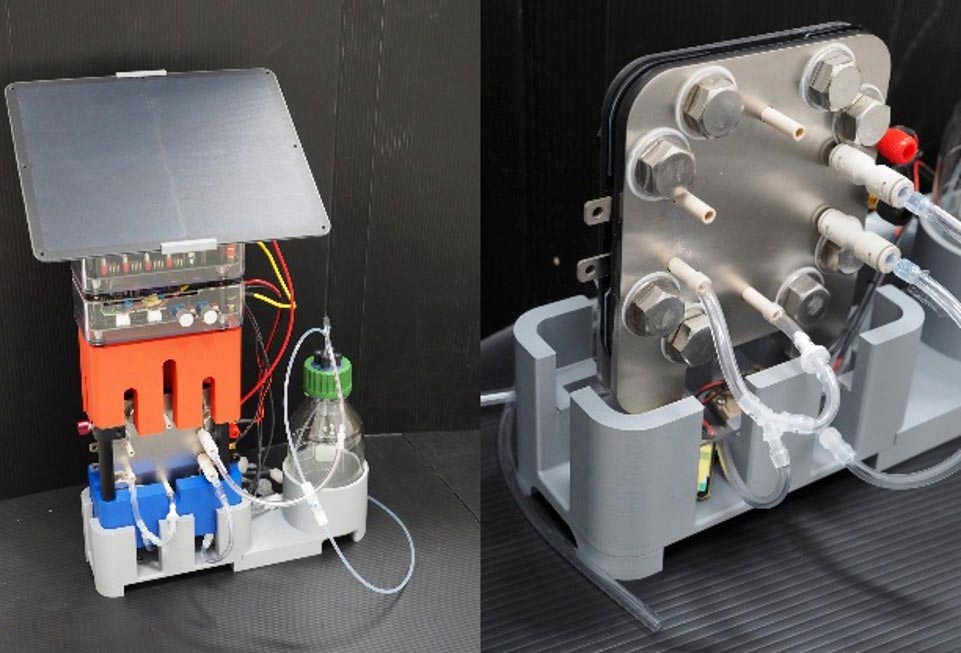
A self-regulating artificial photosynthesis system makes solar fuel without batteries, offering a simpler and potentially cheaper path to clean energy storage.
Researchers at Osaka Metropolitan University have created a new artificial photosynthesis system that can produce solar fuel more consistently while eliminating the need for battery-based control systems. The advance comes from incorporating a self-regulating chemical component directly into the electrolyzer, removing one of the more costly elements commonly used in these technologies.
Like natural photosynthesis in plants, artificial photosynthesis uses sunlight to transform water and carbon dioxide into useful fuels. One example is formic acid, a chemical that can store energy for later use.
How Artificial Photosynthesis Produces Fuel
A key part of the process is the electrolyzer. This device converts electricity generated by solar cells into chemical energy, allowing fuel such as formic acid to be produced and stored.
One challenge is maintaining efficient operation as sunlight levels rise and fall throughout the day. To address this, many artificial photosynthesis systems rely on Maximum Power Point Tracking (MPPT), a control method that continually adjusts voltage and current so solar cells can operate at maximum efficiency.
However, MPPT systems often require batteries and additional electronic components to stabilize energy flow. While effective, these extra parts add both cost and complexity.
Self-Regulating Electrolyzer Eliminates Batteries
To simplify the system, a research team led by Associate Professor Yasuo Matsubara and Professor Yutaka Amao at the Research Center for Artificial Photosynthesis at Osaka Metropolitan University, working with Iida Group Holdings Co., Ltd, redesigned the electrolyzer using a special solid electrolyte.
In the new design, the electrolyzer performs the MPPT function on its own, removing the need for batteries and external control hardware.
Rather than relying on separate electronics, converters, and batteries to optimize performance, the electrolyzer automatically adjusts its electrical characteristics by varying its thermal and impedance properties.
“As sunlight increases, the electrolyzer naturally heats up. The system is designed so that this warming causes the electrical resistance to drop, allowing electricity to flow more freely,” Professor Amao explained. “This makes the system automatically adjust its electrical behavior.”
“This self-regulating behavior helps keep fuel production more stable throughout the day and automates the system, while reducing dependence on batteries and costly external components,” he added.
Stable Solar Fuel Production in Real Sunlight
When researchers tested a prototype incorporating the technology, it successfully and consistently produced formic acid from water and CO2 under real outdoor sunlight, even when light levels changed.
“We were confident that it would be successful, as we previously showcased this research at the ‘Joint Pavilion Iida Group × Osaka Metropolitan University’ exhibition as part of the Osaka Kansai Expo 2025,” Professor Matsubara said. “It successfully generated enough formic acid to power a miniature diorama in the pavilion, showing its potential as an efficient artificial photosynthesis system that could potentially be used to charge applications in our homes.”
The findings were published in the journal EES Solar.
Reference: “Chemical maximum-power-point tracking system for stabilized liquid solar-fuel production” by Yasuo Matsubara, Hinako Kawakami, Yasuhito Kajita and Yutaka Amao, 20 March 2026, EES Solar.
DOI: 10.1039/D5EL00177C
Never miss a breakthrough: Join the SciTechDaily newsletter.
Follow us on Google and Google News.
Full article can be found at: https://scitechdaily.com/battery-free-artificial-photosynthesis-turns-sunlight-water-and-co2-into-fuel/


