



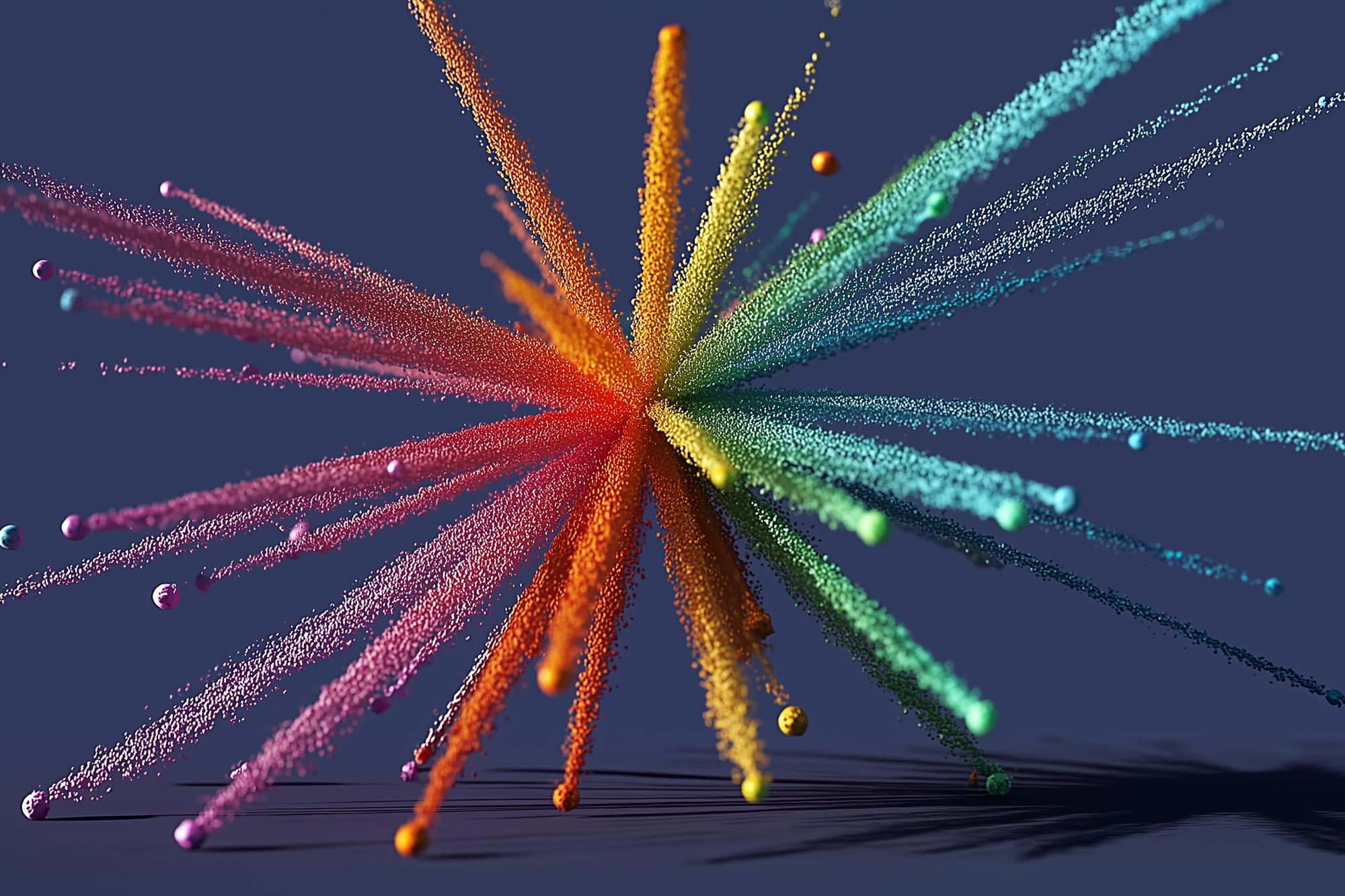
Scientists have finally cracked the hidden geometry behind how humans perceive color.
New research into how humans perceive color differences is helping resolve questions tied to a theory first proposed nearly 100 years ago by physicist Erwin Schrödinger. A team led by Los Alamos National Laboratory scientist Roxana Bujack used geometry to mathematically describe how people experience hue, saturation and lightness. Their findings, presented at a visualization science conference, strengthen and formalize Schrödinger’s model by showing these color qualities are fundamental properties of the color system itself.
“What we conclude is that these color qualities don’t emerge from additional external constructs such as cultural or learned experiences but reflect the intrinsic properties of the color metric itself,” Bujack said. “This metric geometrically encodes the perceived color distance — that is, how different two colors appear to an observer.”
By formally defining these perceptual characteristics, the researchers believe they have supplied a crucial missing piece in Schrödinger’s long-standing vision of a complete model capable of defining hue, saturation, and lightness entirely through geometric relationships between colors.
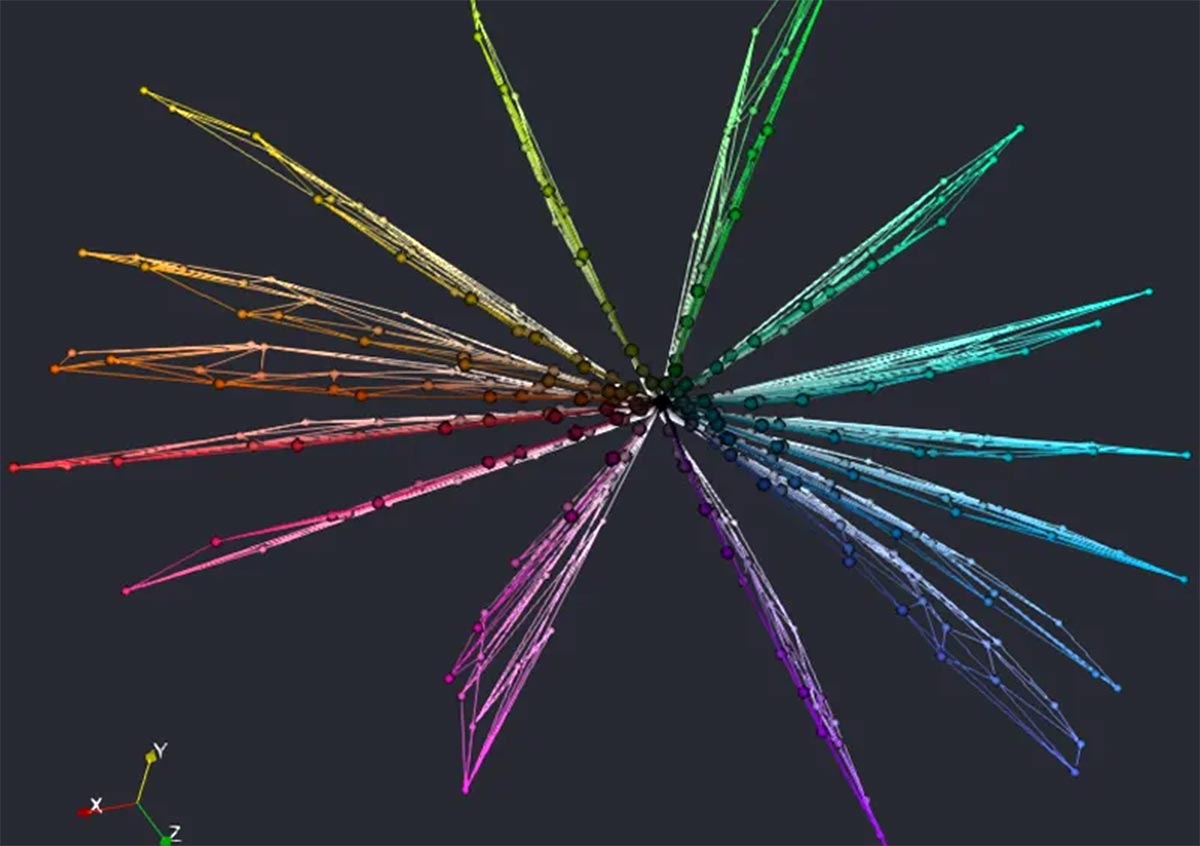
The Geometry Behind Human Color Vision
Human eyes contain three types of cone cells that detect color, each tuned primarily to red, blue, and green light. This creates a three-dimensional framework that scientists use to organize colors, known as color space. In the 19th century, mathematician Bernhard Riemann proposed that these perceptual spaces may be curved rather than flat. Building on that idea in the 1920s, Schrödinger developed mathematical definitions for hue, saturation and lightness using a Riemannian model of color perception.
For decades, Schrödinger’s work served as a foundation for understanding color attributes. But while developing algorithms for scientific visualization, the Los Alamos researchers uncovered weaknesses in the mathematical structure behind the theory. Those issues ultimately led the team to rethink and improve the framework.
Solving the Neutral Axis Problem
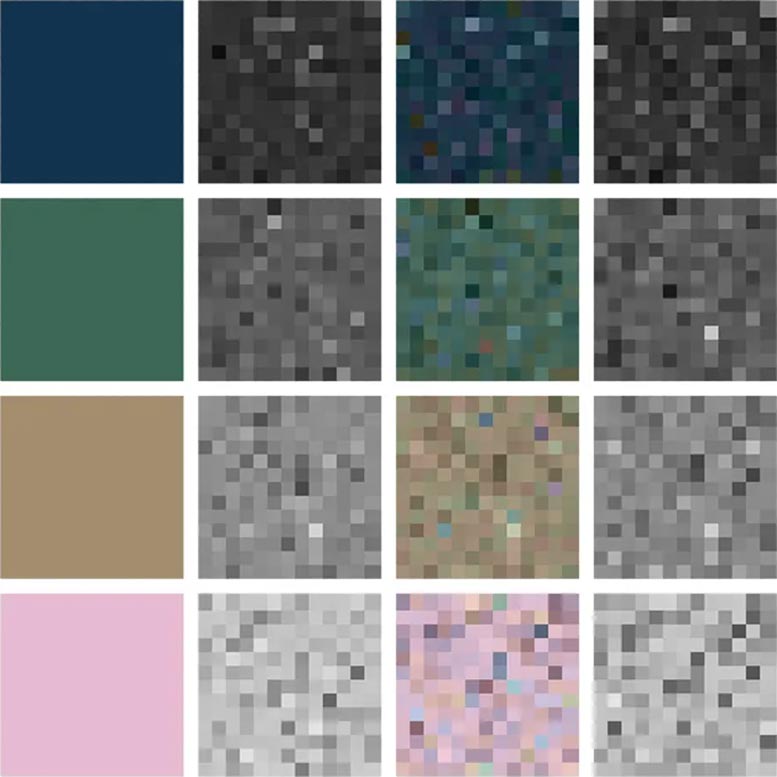
One of the biggest challenges involved the “neutral axis,” the line of gray shades stretching from black to white. Schrödinger’s definitions depend on a color’s position relative to this axis, yet he never mathematically defined the axis itself. Without that foundation, the model lacks a complete formal basis.
The researchers’ most significant breakthrough was defining the neutral axis entirely through the geometry of the color metric. To accomplish this, the team moved beyond the traditional Riemannian framework, marking an important advance in visualization mathematics.
The team also corrected two other issues in color perception modeling. One involved the Bezold-Brücke effect, where changes in light intensity can alter the way a hue appears. Instead of relying on straight-line geometry, the researchers used the shortest possible path through the perceptual color space. They applied the same shortest-path approach in a non-Riemannian space to better explain diminishing returns in color perception, where larger color differences become progressively harder to distinguish.
Advancing Visualization Science
Presented at the Eurographics Conference on Visualization, the work represents the culmination of a larger color perception project that also produced a major 2022 paper published in the Proceedings of the National Academy of Sciences.
A more precise understanding of color perception could have wide-ranging applications. Visualization science plays an important role in photography, video technology, scientific imaging, and data analysis. Accurate color models also help researchers interpret complex information more effectively, supporting fields that range from advanced simulations to national security science. The study also lays the groundwork for future color modeling in non-Riemannian space.
Reference: “The Geometry of Color in the Light of a Non-Riemannian Space” by Roxana Bujack, Emily N. Stark, Terece L. Turton, Jonah M. Miller and David H. Rogers, 23 May 2025, Computer Graphics Forum.
DOI: 10.1111/cgf.70136
Funding: This work was supported by the Laboratory Directed Research and Development program at Los Alamos and by the National Nuclear Security Administration’s Advanced Simulation and Computing program.
Never miss a breakthrough: Join the SciTechDaily newsletter.
Follow us on Google and Google News.
Full article can be found at: https://scitechdaily.com/scientists-solve-100-year-old-schrodinger-mystery-about-color-perception/


