



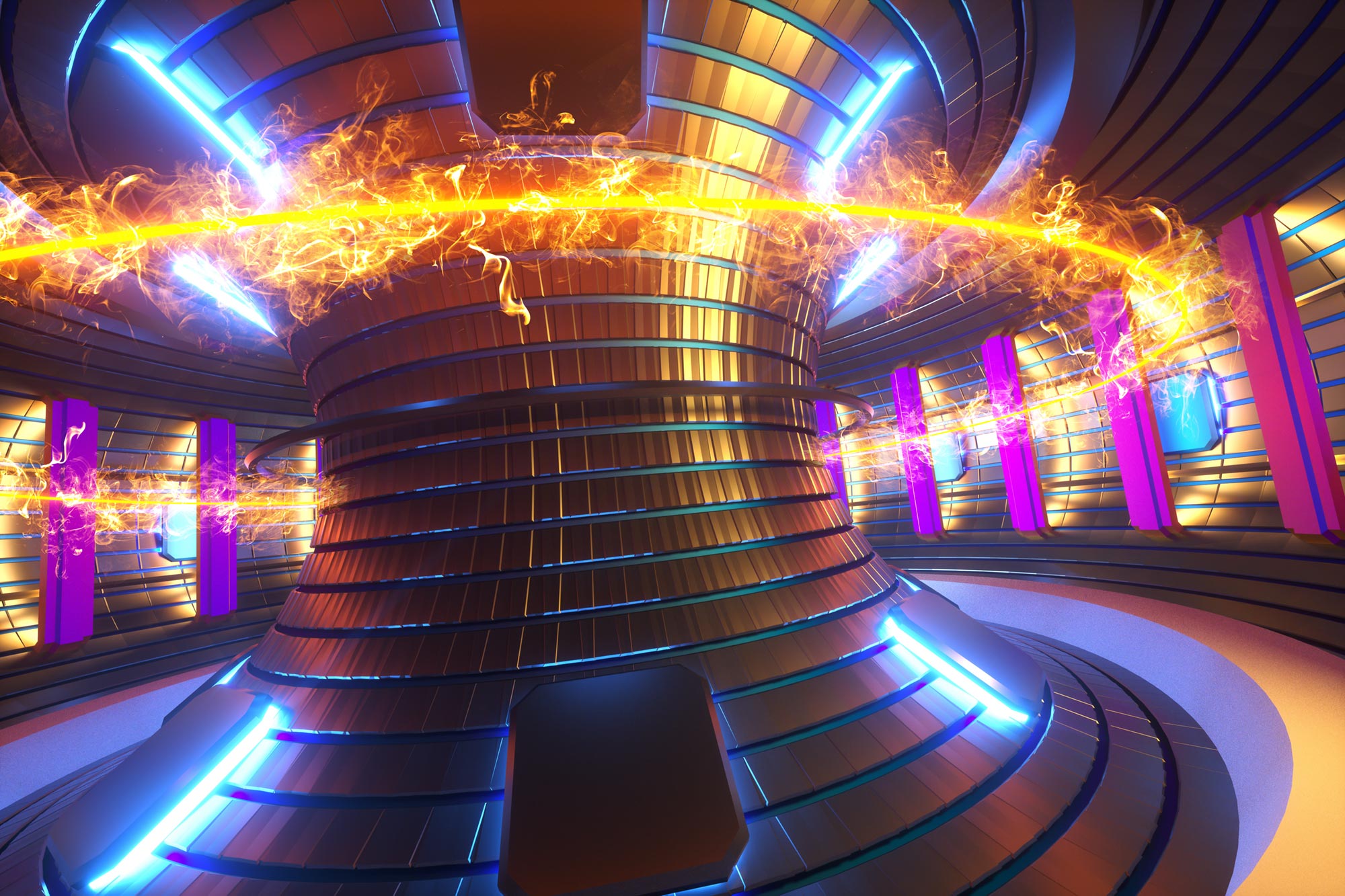
Scientists have demonstrated a new plasma operating regime that could help solve two of fusion energy’s biggest challenges at once.
Inside a fusion reactor, matter is heated to temperatures hotter than the Sun and confined by powerful magnetic fields. But keeping this superheated plasma stable long enough to produce usable energy remains one of the field’s toughest challenges.
One major problem is that the plasma edge can unleash violent bursts of energy capable of damaging reactor walls, while the exhaust system must also withstand enormous heat loads comparable to those on a spacecraft during reentry.
Now, researchers in China may have found a way to tackle both issues at once.
A team led by Professor Guosheng Xu at the Institute of Plasma Physics, part of the Hefei Institutes of Physical Science under the Chinese Academy of Sciences, has demonstrated a new plasma operating regime on the EAST fusion device that simultaneously reduces heat striking reactor components, suppresses damaging instabilities, and maintains strong energy confinement. The achievement, sustained for roughly a minute in a metal-wall environment, was recently published in Physical Review Letters.
Fusion Challenges: Heat Loads, ELMs, and Stability
Fusion reactors work by confining plasma — an extremely hot, electrically charged gas — inside magnetic fields. For fusion power plants to operate continuously, they must maintain high temperatures and strong confinement while safely removing excess heat and particles from the plasma edge.
One of the most vulnerable regions is the divertor, a specialized exhaust system that handles escaping heat and particles. Under normal conditions, the divertor can experience immense heat fluxes that threaten to erode reactor materials. Scientists often inject small amounts of impurity gases to cool this region through a process called detachment, where the plasma partially separates from the divertor surface. However, excessive cooling can also reduce the plasma’s performance.
Another major issue involves edge-localized modes, or ELMs, sudden eruptions of heat and particles from the plasma edge that behave somewhat like solar flares. These bursts are common in high-confinement, or H-mode, plasmas, which are otherwise desirable because they trap energy efficiently. Eliminating ELMs without sacrificing confinement has long been considered a key hurdle for future fusion reactors.
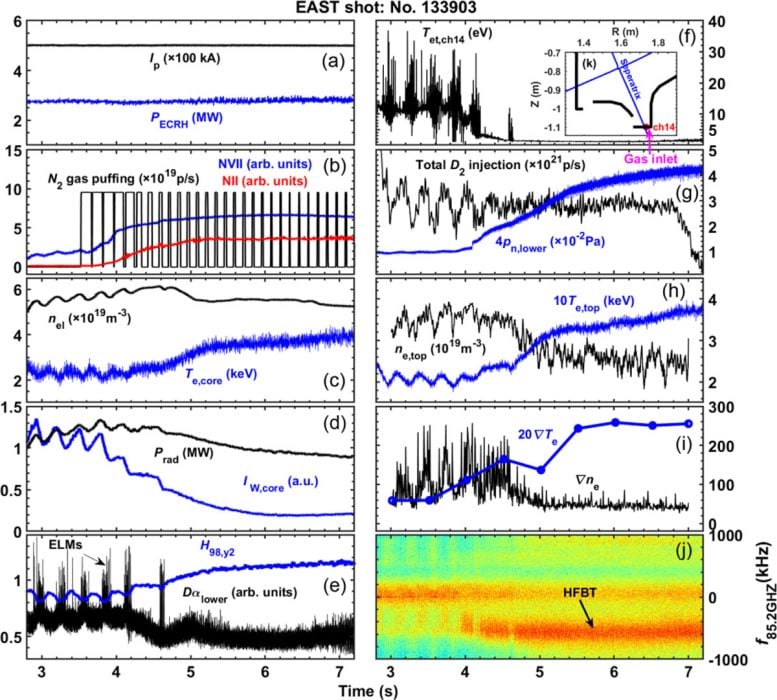
In the new study, the researchers precisely controlled the injection of light impurity gases inside the EAST tokamak to create what they call the Detached divertor and Turbulence-dominated Pedestal (DTP) regime.
DTP Regime: Gas Seeding and Plasma Control Innovation
Through precise, real-time adjustment of gas input, the researchers achieved partial divertor detachment without compromising stability. Under these conditions, heat reaching the divertor plates dropped significantly, ELMs were fully eliminated, and the pedestal electron temperature rose, improving energy confinement. The combination of partial detachment and a closed divertor design helped trap and remove neutral particles, which reduced cooling at the plasma edge and strengthened the temperature gradient.
The steeper gradient triggered microturbulence, specifically temperature-gradient-driven trapped electron modes, which naturally moved heat and particles outward. This process limited pressure buildup in the pedestal, prevented ELMs, and supported stable, high-performance plasma operation for about a minute, marking important progress toward sustained, long-pulse fusion.
According to the researchers, this work points to a promising way to balance divertor heat control with efficient plasma confinement, addressing a long-standing challenge in fusion energy development.
Reference: “Turbulence-Driven Edge-Localized-Mode-Free High-Confinement Mode with Divertor Detachment in a Metal-Wall Tokamak” by G. S. Xu, G. F. Ding, G. J. Zhang, Y. F. Wang, X. Jian, T. Zhang, Z. Q. Zhou, K. Wu, Q. Q. Yang, R. Chen, L. Yu, L. Y. Meng, L. Wang, H. Q. Wang, N. M. Li, Z. Y. Lu, K. D. Li, S. Y. Ding, N. Yan, L. Q. Xu, X. Lin, B. Zhang, J. P. Qian, T. F. Zhou, P. Li, C. Zhou, S. F Wang, Q. Zang, H. Q. Liu, F. Ding, L. Zhang, Y. F. Jin, Y. M. Duan, Y. W. Yu, R. Ding, G. Q. Li, X. Z. Gong, K. Lu, J. S. Hu, Y. T. Song and B. N. Wan, 23 March 2026, Physical Review Letters.
DOI: 10.1103/7r3f-dqft
Never miss a breakthrough: Join the SciTechDaily newsletter.
Follow us on Google and Google News.
Full article can be found at: https://scitechdaily.com/scientists-may-have-solved-two-of-fusion-energys-biggest-problems-at-once/


