



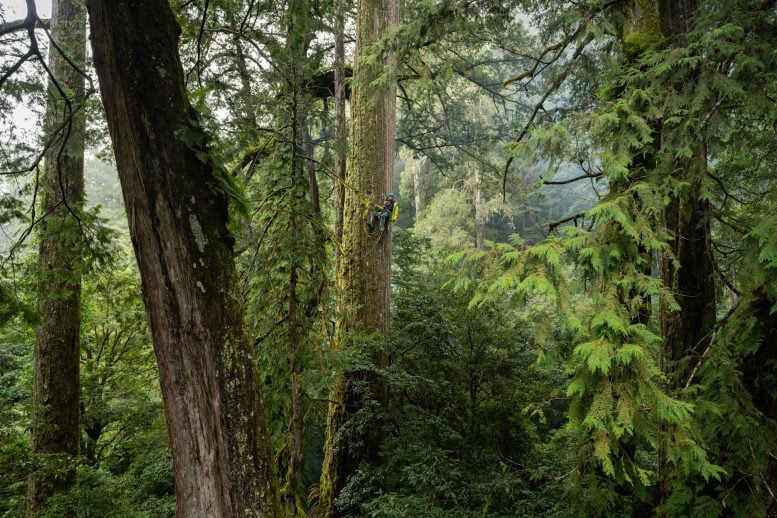
A decade-long search through Taiwan’s remote forests led to the discovery of East Asia’s tallest tree and hundreds of other towering giants.
An 84-meter-tall tree is surprisingly easy to miss.
Hidden within Taiwan’s steep mountains and dense old-growth forests are some of the tallest trees on Earth, including giant conifers that rise higher than a 25-story building. For years, these towering giants remained largely unknown, concealed in remote valleys that few people ever visit.
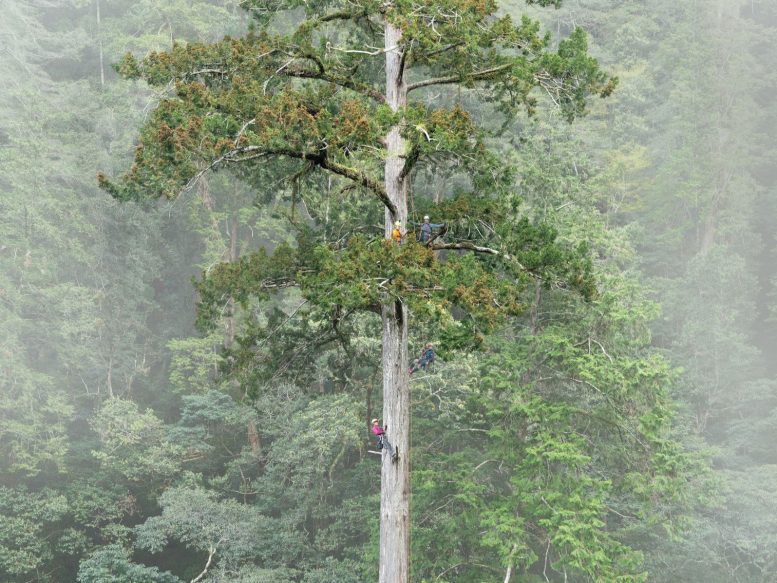
Since 2014, the “Taiwan Tree Seekers” have been searching for and documenting these remarkable forests. Bringing together professional tree climbers, ecologists, geologists, and remote sensing specialists, we spent nearly a decade tracking down the island’s largest trees. That effort culminated in 2023 with the discovery of an 84.1-meter-tall (276-foot) Taiwania fir (Taiwania cryptomerioides), now recognized as the tallest known tree in East Asia. The Indigenous Rukai people have long referred to these immense trees by a more poetic name: “the tree that hits the moon.”
The conditions that allow such giants to flourish are rooted in Taiwan’s extraordinary geography. Although the island covers only about 36,000 square kilometers (13,900 square miles), roughly the size of Switzerland, it contains 258 peaks above 3,000 meters (9,843 feet), creating a landscape of deep valleys, rugged slopes, and diverse climates unlike anywhere else on Earth.
This rugged terrain supports extraordinary biodiversity. An estimated 5,000 plant species grow across ecosystems that range from tropical rainforests at sea level to alpine tundra near the highest summits.
About 60% of Taiwan remains forested, providing habitat for an estimated 950 million trees. Although industrial logging from 1912 to 1991 greatly reduced much of the island’s original forest, the steepest and most inaccessible areas protected valuable pockets of old-growth woodland from being harvested.
The Search for Taiwan’s Forest Giants Begins
The search formally started in August 2014 when researchers from the Taiwan Forestry Research Institute (TFRI) launched an expedition into the Cilan Conservation Area. Their goal was to investigate the legendary “Chilan Three Sisters,” a group of giant Taiwania firs known locally but never carefully measured or scientifically documented.
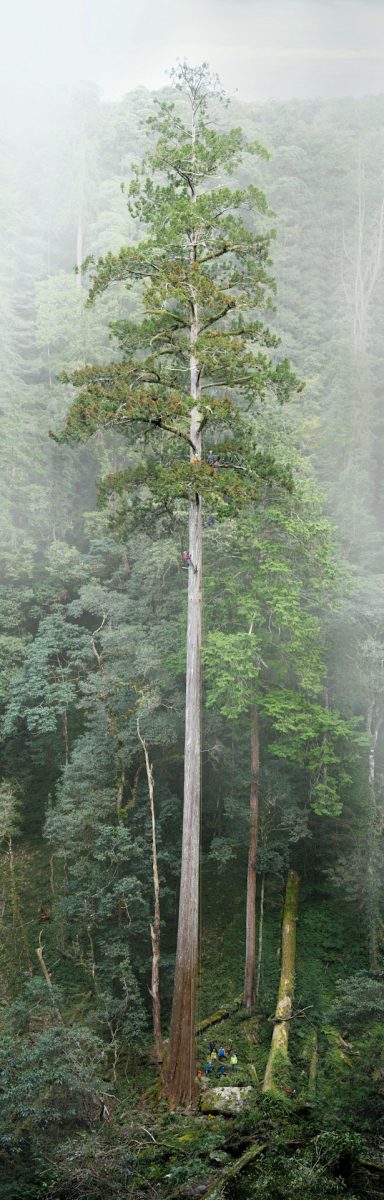
The tallest of the three reached 69.3 meters (227 feet), with a trunk nearly three meters (9.8 feet) in diameter. International interest grew in 2017 when climbers from Australia’s “The Tree Projects” traveled to Taiwan to photograph the trees, helping showcase the island’s remarkable forests to a global audience.
Encouraged by those findings, the team turned its attention to a more remote area near Mt. Benya, believed to contain the largest concentration of Taiwania firs. Located near the sacred Great Ghost Lake, the site required four days of difficult hiking to reach.
That expedition changed the direction of the project. The researchers realized that accurately identifying the tallest trees from the forest floor was nearly impossible. In the dense canopy of an old-growth forest, visual estimates can be misleading. Although the team climbed a 71.7-meter (235-foot) tree during the trip, they recognized the need for a more reliable method.
LiDAR Technology and Citizen Science Transform the Hunt
Searching for a handful of giant trees among 950 million trees spread across remote valleys was like searching for a needle in a haystack. To improve the process, the team partnered with remote sensing specialists at National Cheng Kung University and adopted LiDAR (Light Detection and Ranging) technology. This airborne laser scanning system creates detailed 3D maps by measuring how long laser pulses take to bounce back from the ground and vegetation, making it possible to estimate tree heights across vast areas.
However, Taiwan’s steep terrain created challenges. Automated measurements often exaggerated tree heights, especially when trees stood next to cliffs or other dramatic landscape features. Human observers proved much better at spotting these geological illusions. In 2020, the project expanded into a citizen science effort, with hundreds of volunteers reviewing LiDAR images and helping eliminate false candidates. Their work revealed that 93% of trees had been incorrectly measured by the automated system.
Without this public assistance, the team would have spent years visiting trees that turned out to be much shorter than expected. By the end of 2022, the collaboration produced the “Taiwan Giant Tree Map,” which identified 941 trees taller than 65 meters (213 feet).
Discovering East Asia’s Tallest Tree
During the Lunar New Year holiday in January 2023, the team used the new map to investigate the leading candidate for Taiwan’s tallest tree. Reaching it required a demanding expedition that included a 20-kilometer (12.4-mile) river trek and two days of steep climbing.
After climbers reached the crown and lowered a measuring tape from the top to the ground, the final height was confirmed at 84.1 meters (276 feet). The tree was named the “Heaven Sword of the Da’an River” and officially recognized as the tallest known tree in Taiwan and East Asia.
By early 2026, the project had documented and climbed ten Taiwania trees taller than 70 meters (230 feet), including two that exceeded 80 meters (262 feet).
Temples of Giants and Carbon-Rich Forests
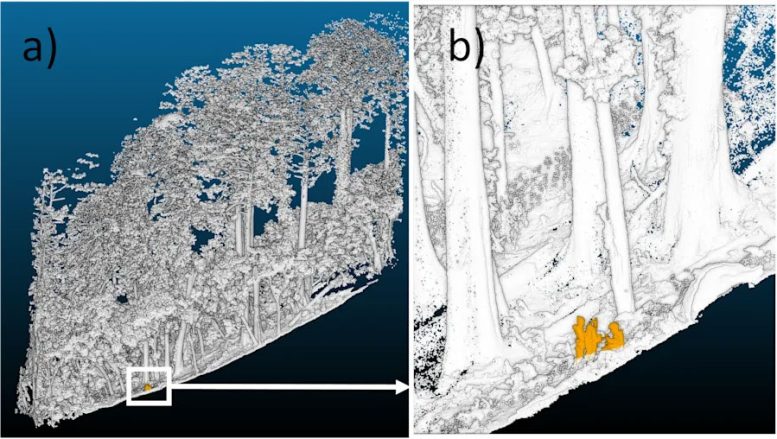
The Giant Tree Map also led researchers to extraordinary concentrations of giant trees. Near Mt. Benya, they discovered a single-hectare (2.47-acre) forest containing 11 trees taller than 65 meters (213 feet). A decade after their first visit to the Great Ghost Lake region, they returned to find a dense ancient stand containing about 30 giant Taiwania firs growing together.
These forests play an important role in the global environment. In 2024, researchers and 15 citizen scientists studied the “Tao Tree” valley, home to Taiwan’s third-tallest tree, to determine how much carbon dioxide the forest absorbs and stores.
The findings were remarkable. The forest’s carbon density, even without including its extensive root systems, measured 1,384.5 Mg/ha. This places Taiwan’s giant forests among the most carbon-dense ecosystems on Earth, comparable to some of the world’s most celebrated old-growth forests. These “trees that hit the moon” are not only natural wonders but also vital protectors of the environment.
Reference: “The journey of finding the tallest tree in Formosa Taiwan” by Rebecca Chia-Chun Hsu, Chi-Kuei Wang and Chung-Cheng Lee, 13 April 2026, Frontiers in Forests and Global Change.
DOI: 10.3389/ffgc.2026.1746112
Never miss a breakthrough: Join the SciTechDaily newsletter.
Follow us on Google and Google News.
Full article can be found at: https://scitechdaily.com/scientists-have-found-the-heaven-sword-after-years-of-looking/


