




Researchers have uncovered compelling evidence about the elusive structure of a high-pressure phase of solid nitrogen.
Nitrogen makes up most of Earth’s atmosphere, but under intense pressure and low temperatures, it can form solid phases with unexpectedly complex structures. One of these phases, γ-N2, remained poorly understood for more than 50 years despite repeated experimental and theoretical studies.
Researchers have now found strong evidence that γ-N2 adopts a monoclinic P21/c structure containing two nitrogen molecules in each unit cell. The result confirms a long-standing theoretical prediction and clarifies the structure of a phase that appears to occupy much more of nitrogen’s pressure and temperature range than scientists once believed.
Solving a Difficult Structural Puzzle
The study was led by Professor Xiaodi Liu of the Hefei Institute of Solid State Physics at the Hefei Institutes of Physical Science, Chinese Academy of Sciences. The team worked with researchers from the University of Edinburgh and other international institutions. Their findings were published in Matter and Radiation at Extremes.
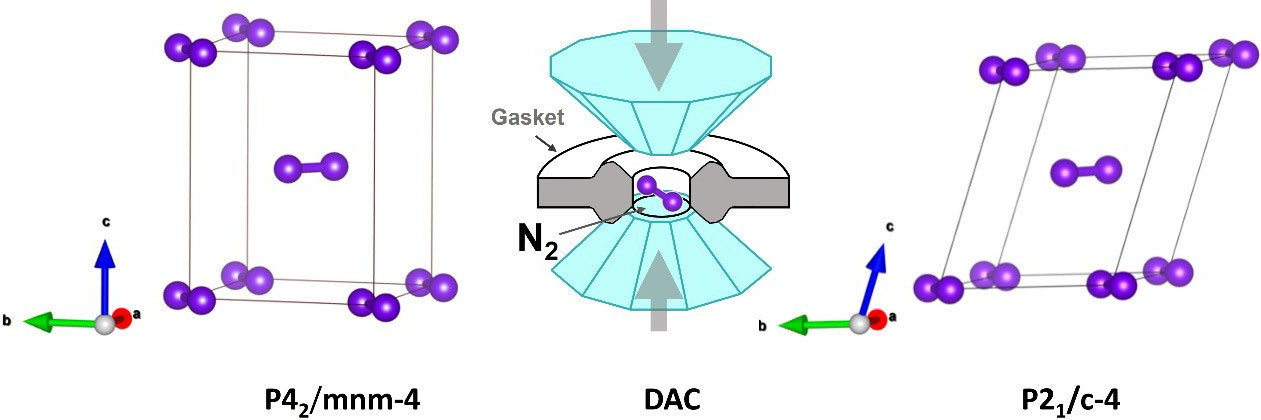
Determining the structure of γ-N2 has been unusually difficult because the phase cannot easily be grown as a high-quality single crystal. Instead, it often forms as a poor-quality powder, making standard structural analysis less conclusive.
To overcome this problem, the researchers combined synchrotron X-ray diffraction, Raman spectroscopy, infrared spectroscopy, and density functional theory calculations. The agreement among these methods allowed the team to distinguish the P21/c structure from several competing models.
An Unexpected Isotope Effect
Earlier Raman measurements had revealed an extra vibrational signal that appeared inconsistent with the proposed structure. The new study showed that the signal did not come from a different crystal arrangement.
Instead, it was linked to a small number of nitrogen molecules containing the rare nitrogen-15 isotope. As pressure increased, this weaker vibration moved closer to a stronger vibration from ordinary nitrogen molecules, causing the two signals to interact. The researchers described the effect as a Fermi-like resonance.
The team also found that γ-N2 is closely related to another solid phase, θ-N2. The two phases have similar Raman signatures and related molecular arrangements, even though they form under very different pressure and temperature conditions.
Reference: “Revisiting the structural and optical properties of γ-N2” by Jinwei Yan, Hai-An Xu, Pu Wang, Lewis J. Conway, Wan Xu, Chuansheng Hu, Zeming Qi, Xiao-Di Liu and Eugene Gregoryanz, 13 May 2026, Matter and Radiation at Extremes.
DOI: 10.1063/5.0315313
Never miss a breakthrough: Join the SciTechDaily newsletter.
Follow us on Google and Google News.
Full article can be found at: https://scitechdaily.com/scientists-finally-solve-a-50-year-mystery-hidden-in-solid-nitrogen/


