




TU Wien has detected strong quantum entanglement for the first time in a centimeter-sized crystal of a strange metal.
Many quantum effects are easiest to detect in very small systems, such as individual atoms, molecules or photons, that are carefully isolated from their surroundings. But physicists have long wondered whether much larger objects, made of enormous numbers of particles, can also reveal unmistakable signs of quantum behavior.
Experimentalists at TU Wien have now shown that they can. The group studied a centimeter-sized crystal of a so-called strange metal and found evidence of a high level of quantum entanglement. The measurement was made possible by a precise tool from quantum information theory called quantum Fisher information.
The result creates a new link between solid state physics and quantum physics. It shows that quantum entanglement can be directly measured in a large strange metal material.
Cats or ants?
The question of whether the strange predictions of quantum theory can apply to large, everyday scale objects goes back almost to the beginning of quantum mechanics. Erwin Schrödinger famously asked whether a cat could be dead and alive at the same time. Since then, many experiments have tried to deliberately produce quantum effects in increasingly large systems.
“Our approach is different,” says Prof. Silke Bühler Paschen from the Institute of Solid State Physics at TU Wien. “We do not try to bring the crystal as a whole into a superposition of two states. Instead, we ask whether its constituents are – collectively – in such a state of entanglement.” The experiment is therefore closer to the behavior of an anthill than to Schrödinger’s cat. When an anthill is disturbed, the response does not come from one ant alone, but from the colony acting collectively.
Quantum Fisher information: entanglement enhances sensitivity
The theoretical foundation for this method was developed by Innsbruck quantum physicist Peter Zoller and his group. They showed that quantum Fisher information can reveal quantum entanglement even in large many body systems.
“The quantum Fisher information quantifies how sensitively a quantum system responds to a change,” explains Bühler Paschen. “For a collection of independent particles, the response is limited because each particle contributes on its own. However, if the particles are entangled, the entire system can respond more strongly than the sum of its individual parts. This enhanced sensitivity is precisely what makes entanglement such a valuable resource for quantum metrology, where one aims to detect extremely small signals with the highest possible precision. By measuring how strongly a system responds to a perturbation, one can therefore infer the degree of entanglement present in the material”
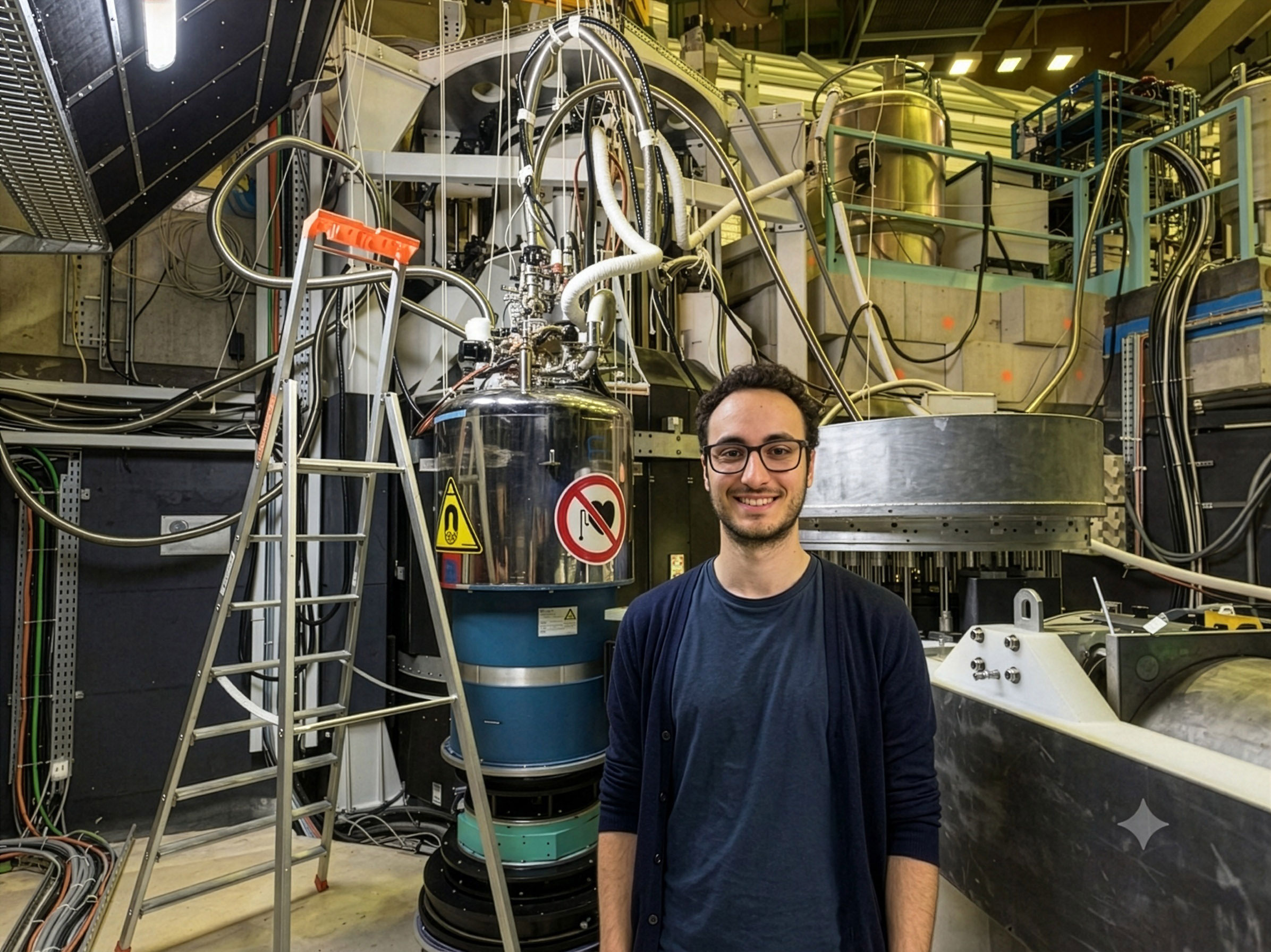
The TU Wien group created a crystal made from cerium, palladium and silicon. This material is a strange metal, a class of material already known for unusual quantum properties, many of which remain poorly understood. At the ILL in Grenoble, PhD student Federico Mazza exposed the crystal to neutrons and measured how it reacted.
One neutron asks a question — at least nine particles answer
“In a normal material, one would expect a neutron to transfer its energy to an individual particle,” says Mazza. “But by analyzing the data using the quantum Fisher information, we found a response that cannot be explained in terms of independent particles. Instead, it indicates that groups of at least nine quantum-entangled entities act collectively.” This gives direct evidence of strong multipartite quantum entanglement in a solid object large enough to hold comfortably in one hand.
The background: research on strange metals
The study was motivated by the effort to understand the strange metal behavior of the crystal. Similar behavior appears in other material classes, including high-temperature superconductors. Research in this area has accelerated in recent years as more unusual properties have emerged. In 2025, a collaboration between TU Wien and Rice University in the United States found that electric current moves through such materials in a surprisingly “quiet,” low-noise way. The discovery of entanglement now offers a possible explanation: the particles have not vanished, but instead coordinate their behavior to suppress current fluctuations.
“What we see here is not a detail of one particular material, but a general physical principle,” says Fakher Assaad from the University of Würzburg, lead theorist of the work. “Strong entanglement appears to be directly linked to the unusual behavior of strange metals.”
“The results are a great success for us,” says Silke Bühler Paschen. “They confirm that our unusual approach of using methods from quantum information science for solid-state physics studies of novel materials can reveal fundamentally new insight.” The next goal is already clear: “We want the transfer of knowledge between the two fields to also work in the other direction. Our aim is to explore whether strange metals may one day find applications in quantum technologies — for example in high-precision measurements for quantum metrology.”
Reference: “Quantum Fisher information in a strange metal” by Federico Mazza, Sounak Biswas, Xinlin Yan, Andrey Prokofiev, Paul Steffens, Qimiao Si, Fakher F. Assaad and Silke Paschen, 15 June 2026, Nature Physics.
DOI: 10.1038/s41567-026-03298-0
Never miss a breakthrough: Join the SciTechDaily newsletter.
Follow us on Google and Google News.
Full article can be found at: https://scitechdaily.com/scientists-discover-quantum-entanglement-in-a-crystal-you-can-hold/


