



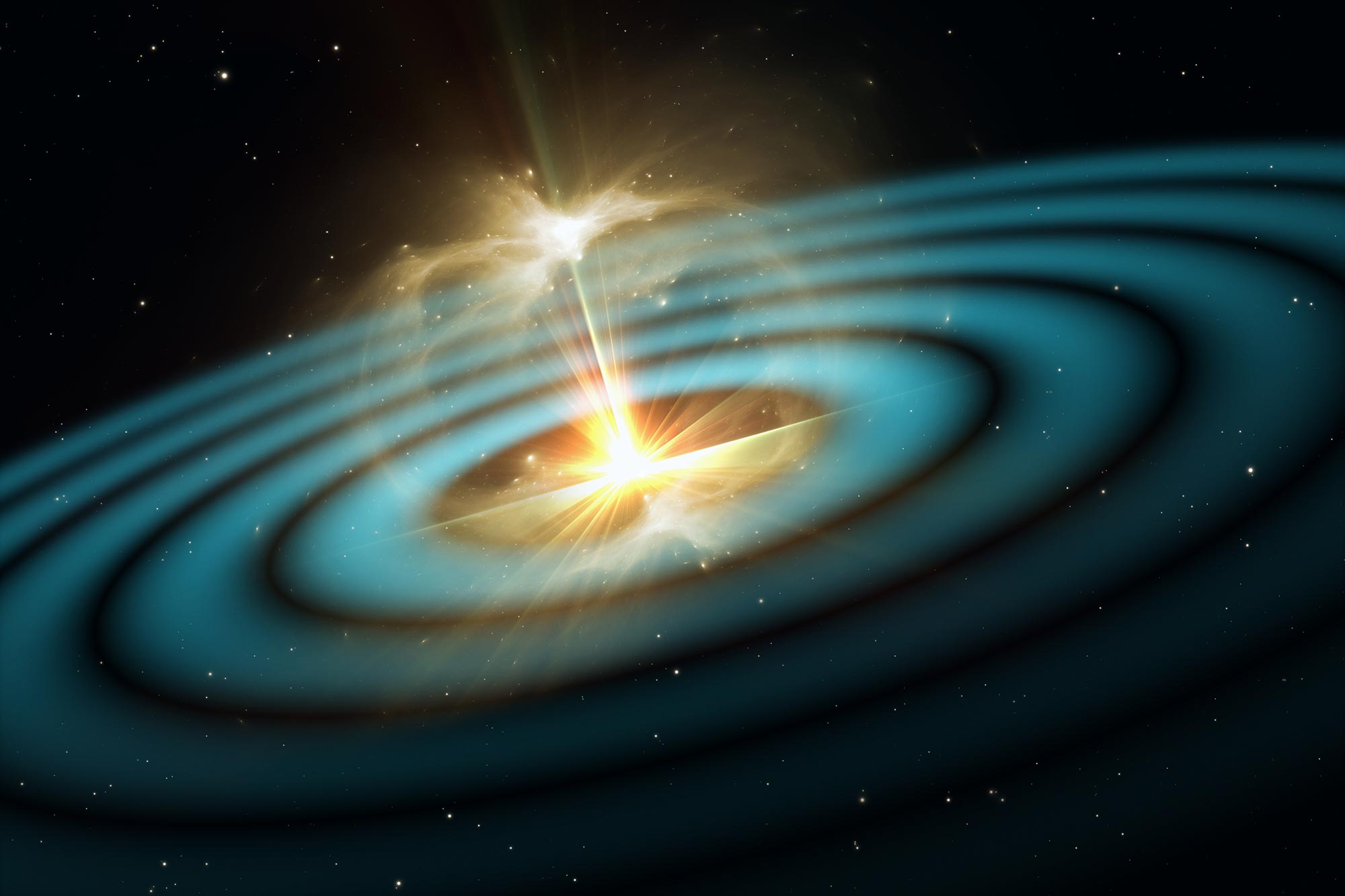
A new detector-based method clarifies how gravitational waves should be measured in an evolving universe.
Imagine trying to measure a ripple on the surface of a pond while the pond itself is slowly changing shape. That is the challenge scientists face when they study gravitational waves not as isolated signals from colliding black holes, but as part of the evolving universe itself.
Gravitational waves are tiny distortions in spacetime. Their first direct detection in 2015 opened a new era in astronomy, giving scientists a way to observe cosmic events that do not rely on light. Since then, researchers have become highly skilled at interpreting waves that travel through mostly empty, relatively calm regions of space. The signals from merging black holes are a clear example.
In those familiar cases, the setup is comparatively clean. The wave can be treated as a small disturbance passing through a stable background, and detectors measure the resulting stretch and squeeze in spacetime. The “wave” and the “background” can be separated in a meaningful way.
Why the Whole Universe Makes the Problem Harder
Cosmology changes the picture. Instead of studying a wave moving through an otherwise quiet patch of space, researchers must consider the universe as a whole. That includes spacetime itself, along with everything inside it, such as stars, galaxies, black holes, and the large-scale structure of the cosmos.
In this setting, the background is not still. The universe expands, matter is unevenly distributed, and small variations in density and motion constantly influence spacetime. These effects make it much harder to say exactly where the background ends and a gravitational wave begins.
That leads to a deceptively simple question: What does a gravitational wave detector actually measure when the entire universe is in motion?
A More Physical Way To Define the Signal
Dr. Guillem Domènech and colleagues at the Institute of Theoretical Physics at Leibniz University Hannover (LUH) have developed a detector-based framework designed to solve this problem.
Rather than starting with abstract mathematical components of a gravitational field, the team focused on what a real experiment would record. Their model uses two freely falling test masses, or atomic clocks, connected by a beam of light. When a gravitational wave passes through, it can slightly change the time the light takes to travel between them. That change appears as a measurable shift in timing or frequency.
The researchers derived this observable quantity in a coordinate-independent way, including effects up to second order in cosmic fluctuations. In other words, they worked out how to describe the detector’s signal without confusing a real physical effect with an artifact of the mathematical language used to describe the universe.
“Gravitational wave detectors measure differences in the frequencies and arrival times of light beams,” says lead author Guillem Domènech. “We calculate these quantities exactly within an expanding spacetime and distinctly isolate what is genuinely measurable from effects that rely on the mathematical description. This ensures that theoretical predictions for future experiments are rigorous and reliable.”
Building a Bridge Between Theory and Observation
The new approach gives theorists and experimentalists a common way to talk about gravitational wave measurements. In the simple limit of quiet spacetime, it reproduces the familiar signals measured by ground-based interferometers. In the more complex setting of cosmology, it keeps the prediction tied to what an actual detector would see.
That makes the framework especially useful for searches for primordial gravitational waves and other subtle signals spread across the universe. It is also relevant to current and future efforts that use pulsar timing arrays and the space-based observatory LISA.
Reference: “Observable Gravitational Wave Strain at Second Order” by Guillem Domènech, Shi Pi and Ao Wang, 3 June 2026, Physical Review Letters.
DOI: 10.1103/pwbs-xwrh
Never miss a breakthrough: Join the SciTechDaily newsletter.
Follow us on Google and Google News.
Full article can be found at: https://scitechdaily.com/scientists-develop-a-new-way-to-measure-gravitational-waves-in-the-expanding-universe/