




Prostate tumors can vanish from the immune system’s radar. Now, scientists have found a way to strip away that disguise by changing the length of a single RNA molecule.
Researchers have developed a CRISPR-based treatment that changes how prostate cancer cells process messenger RNA, or mRNA. In mice, the approach drew more immune cells into tumors and made immune checkpoint therapy significantly more effective.
Immunotherapy works by helping the immune system recognize and destroy malignant cells. Although it has transformed the treatment of some cancers, it has had limited success against most prostate tumors.
These tumors are often described as “immune cold” because they contain few T cells (a type of immune cell) capable of attacking cancer. Without enough T cells inside the tumor, treatments designed to strengthen an immune response have little to work with.
Why Prostate Cancer Resists Immunotherapy
The study, published in Nature Biomedical Engineering, suggests that abnormal RNA processing helps create this immune resistance. By correcting the problem with an RNA-based CRISPR tool, researchers made prostate tumors more visible to the immune system.
“Immunotherapy is a monumentally different way to treat cancer, and a great way because you don’t have to give patients terrible drugs that kill the cancer but harm healthy cells in the process,” said Eric J. Wagner, PhD, co-author of the study from University of Rochester Medicine. “The problem is that some cancers respond well to immunotherapy, but others develop resistance or don’t respond at all. Our tool strengthens the immune system’s ability to make the cancer go away and could be used in conjunction with existing immunotherapies in prostate and potentially other immune-cold tumor types.”
The discovery grew out of research that began 12 years ago. Wagner’s team initially noticed that many mRNAs (messenger RNAs) were unusually short in glioblastoma (brain cancer) cells. Researchers later found similar shortening across many forms of cancer, suggesting that tumors may use it to alter protein production, adapt to threats, and escape treatment.
How Shortened mRNA Helps Cancer
mRNA acts as an intermediary between DNA and the cellular machinery that builds proteins. It carries genetic instructions copied from DNA and delivers them to the parts of a cell that translate those instructions into proteins.
The length of an mRNA molecule can influence how long it survives and how much protein it produces. Shortened mRNAs are often more stable and harder for cells to regulate. Because they remain active longer, they can drive excessive production of proteins that benefit a tumor.
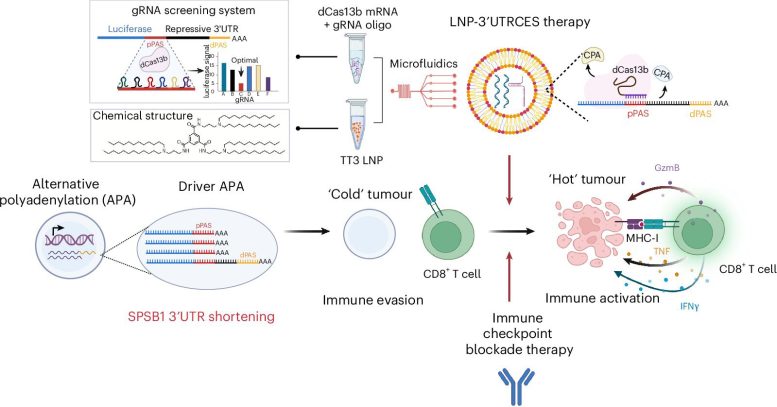
The researchers traced this process to a protein called SPSB1. Its role proved crucial because SPSB1 destroys the MHC-1 complex, a structure that displays molecular clues on the surface of cells and helps T cells recognize potential threats.
The Molecular Disguise Behind Immune Escape
When prostate cancer cells shorten the mRNA carrying the instructions for SPSB1, that molecule becomes more stable and produces additional SPSB1 protein. Rising SPSB1 levels then eliminate more of the MHC-1 complex.
Without enough MHC-1 on their surfaces, malignant cells become harder for T cells to identify. Immune checkpoint therapy may release the immune system’s restraints, but it cannot work effectively when immune cells cannot see their target.
A collaborative team led by Duke University School of Medicine developed a first-of-its-kind strategy to interrupt this process. Using an RNA-based CRISPR Cas13 system, the scientists prevented prostate cancer cells from shortening SPSB1 mRNA.
A CRISPR Tool That Rebuilds RNA
Most CRISPR approaches are designed to cut DNA or RNA. This tool worked differently. It attached to a specific section of the SPSB1 mRNA without slicing it, blocking the machinery that would normally remove part of the molecule’s end, or tail.
Keeping the mRNA at its normal, longer length reduced the amount of SPSB1 produced by the cancer cells. With less SPSB1 available to destroy it, the MHC-1 complex returned to the cell surface.
That restoration effectively exposed the tumors again. More immune cells entered the prostate tumors, and immune checkpoint therapy became substantially better at destroying cancerous cells in mice.
A Potential Strategy for Immune-Cold Tumors
The researchers also conducted an extensive analysis for unintended activity and found no off-target effects from the experimental CRISPR treatment. However, the approach remains preclinical and will require further testing before researchers can determine whether it is safe and effective in people.
“No one has ever done this before. It’s an excellent preclinical model showing that mRNAs can be forced to re-lengthen, and when they do, there’s therapeutic benefit,” said Wagner, professor of biochemistry and biophysics and co-director of the Center for RNA Biology. “Cancer is super smart at evolving, but it’s not a magician. If we can hit it with immunotherapy and another synergistic drug that pumps up the immune response, we could potentially cure it. It won’t be able to evolve fast enough.”
Reference: “Programmable mRNA 3′UTR engineering restores MHC-I and overcomes immune evasion in prostate cancer” by Furong Huang, Fuwen Yuan, Kexin Li, Ya Cui, Lei Li, Wenbin Ye, Zhifen Cui, Jingyue Yan, Qiang Chen, Christopher Nicchitta, Yuebao Zhang, William Hankey, Jeffrey Everitt, Kai-Lieh Huang, Mu-En Wang, Ming Chen, Jiaoti Huang, Hongyan Wang, Eric J. Wagner, Xin Lu, Yizhou Dong, Wei Li and Qianben Wang, 16 June 2026, Nature Biomedical Engineering.
DOI: 10.1038/s41551-026-01720-9
The research was funded by the National Cancer Institute at the National Institutes of Health.
Never miss a breakthrough: Join the SciTechDaily newsletter.
Follow us on Google and Google News.
Full article can be found at: https://scitechdaily.com/new-tool-supercharges-immunotherapy-against-prostate-cancer/


