



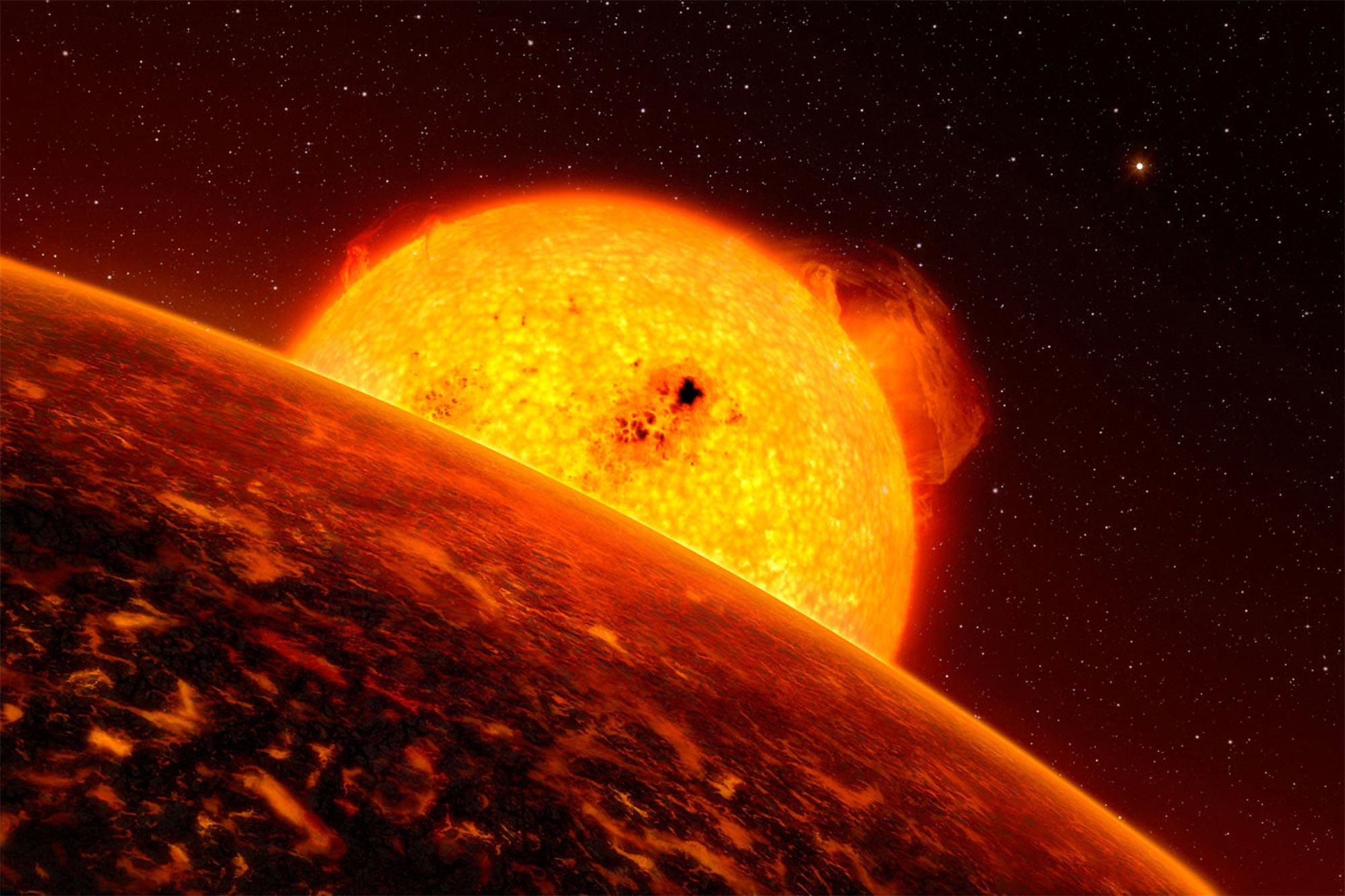
JWST data suggest 55 Cancri e may be a hydrogen-rich lava world with an atmosphere tied to its molten interior.
It is the year 2158, and you are working on a PhD in Planetary Volcanology at the University of Utopia Planitia on Mars. Graduate students are still paid less than they need to live on, so freeze-dried ramen has been your main food for the past three years.
After finishing your study of Jupiter’s moon Io, you now need to look beyond the solar system for a strong exoplanet comparison. Io’s volcanic activity comes from tidal heating, but your project requires a world where volcanism is driven by intense heat from its host star.
You have recently secured funding from the Exoplanet Research Institute for a faster-than-light (FTL) ship, with one requirement: the target exoplanet must be less than 50 light-years away.
Webb targets a lava world
In the present day, scientists have used NASA’s James Webb Space Telescope to study 55 Cancri e (55 Cnc e), a super-Earth with a radius about 1.88 times that of Earth and a mass about 8 times larger. The planet is roughly 41 light-years away, is locked to a Sun-like star and completes an orbit in about 0.7 days.
Scientists think this extremely tight orbit may be hot enough to melt the planet’s surface. For comparison, Mercury takes 88 days to orbit our Sun. The findings were recently submitted to Nature Astronomy and may help scientists better understand how lava exoplanets form and change over time.
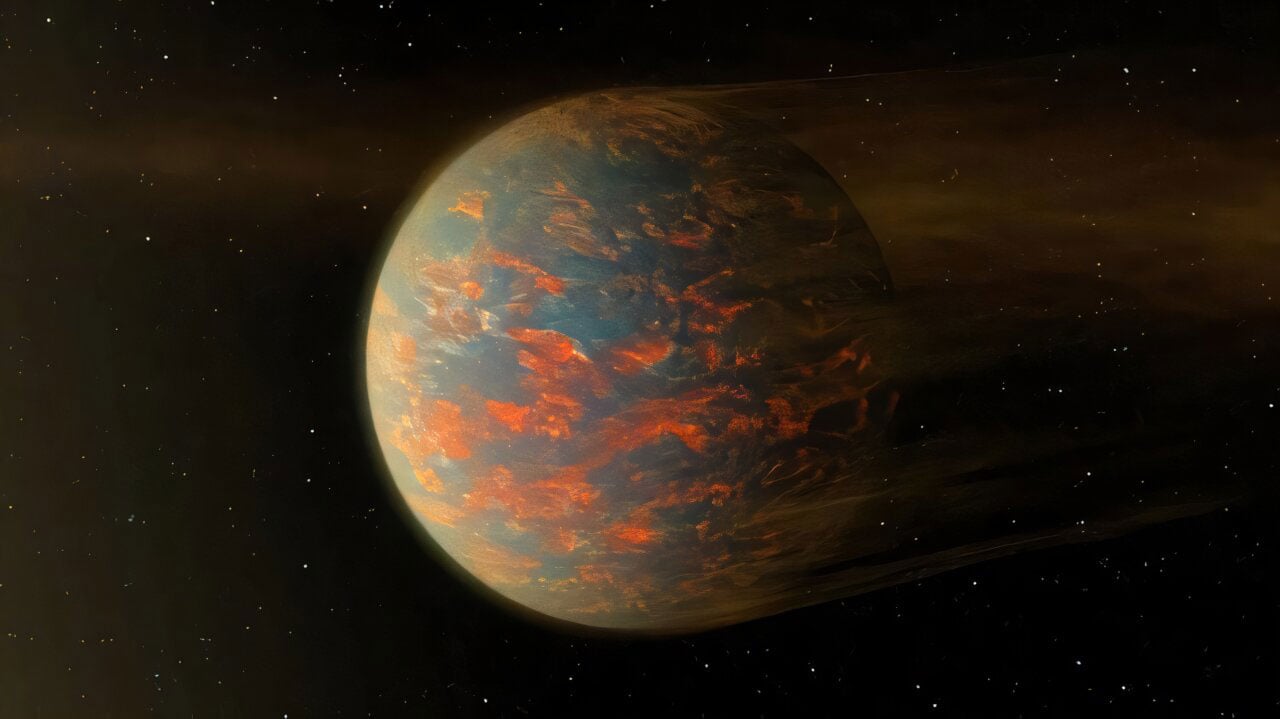
Using JWST, the scientists observed five eclipses of 55 Cnc e and compared the results with long-standing models of exoplanet formation and evolution. Those models suggest that lava planets should contain high levels of carbon monoxide (CO) and carbon dioxide (CO2).
The scientists concluded that the atmosphere of 55 Cnc e is likely made up of large amounts of CO, smaller amounts of CO2, and abundant hydrogen. They also noted that differences across the five eclipses could point to outgassing or to clouds produced by that outgassing. Those clouds could briefly cool the surface before fresh outgassing clears them away.
Chemistry points inward
The study notes, “Since secondary atmospheres of rocky planets are set by the composition of the interior and subsequent outgassing, the composition of their atmospheres is directly linked to their interior redox states. The preference for hydrogen-rich models, together with the steep inversions they produce, therefore suggests an interior with relatively low oxygen fugacity, consistent with outgassing from a reduced magma ocean.”
For context, a planet’s redox state is the chemical balance between oxygen and hydrogen/iron within its interior. In the context of 55 Cnc e, hydrogen is heavily favored compared to oxygen, resulting in the exoplanet’s hydrogen-rich atmosphere.
Lava planets are multiplying
Lava exoplanets have come into the spotlight in recent years, as several have been discovered within the last decade, with 55 Cnc e being discovered in 2004. These exoplanets include K2-141 b, L 98-59 d, TOI-561 b, HD 63433 d, and CoRoT-7 b, which have orbital periods of about 6.7 hours, 7.5 days, 10.5 hours, 4.2 days, and 20.4 hours, respectively. Like 55 Cnc e, all these exoplanets are tidally locked to their host stars and experience extreme temperatures. While 55 Cnc e has its lava on the sun-facing side, exoplanets like L 98-59 d have its entire surface covered in a magma ocean like Jupiter’s moon Io.
Heat drives different volcanism
As noted in the fictionalized tale above, the volcanism on Jupiter’s moon Io is caused by tidal heating, which occurs from the small moon being stretched and compressed by Jupiter’s immense gravity. In contrast, all lava exoplanets listed above, including 55 Cnc e, are the result of the extreme temperatures they endure while orbiting at extremely close distances to their host stars. While Io has volcanism all over its surface, some lava exoplanets have their lava surfaces on the sun-facing side due to them being tidally locked.
What new insights into 55 Cnc e and other lava exoplanets will researchers make in the coming years and decades? Only time will tell, and this is why we science!
As always, keep doing science & keep looking up!
Reference: “Strong and variable stratospheric CO emission from lava-planet 55 Cnc e observed with NIRCam/JWST” by Ignas Snellen, Yamila Miguel, Leoni Janssen, Dario Gonzalez Picos, Sam de Regt, Natalie Grasser and Lars Klijn, 10 June 2026, arXiv.
DOI: 10.48550/arXiv.2606.11866
Adapted from an article originally published in UniverseToday.
Never miss a breakthrough: Join the SciTechDaily newsletter.
Follow us on Google and Google News.
Full article can be found at: https://scitechdaily.com/james-webb-uncovers-the-atmosphere-of-a-hellish-lava-world-41-light-years-away/


