



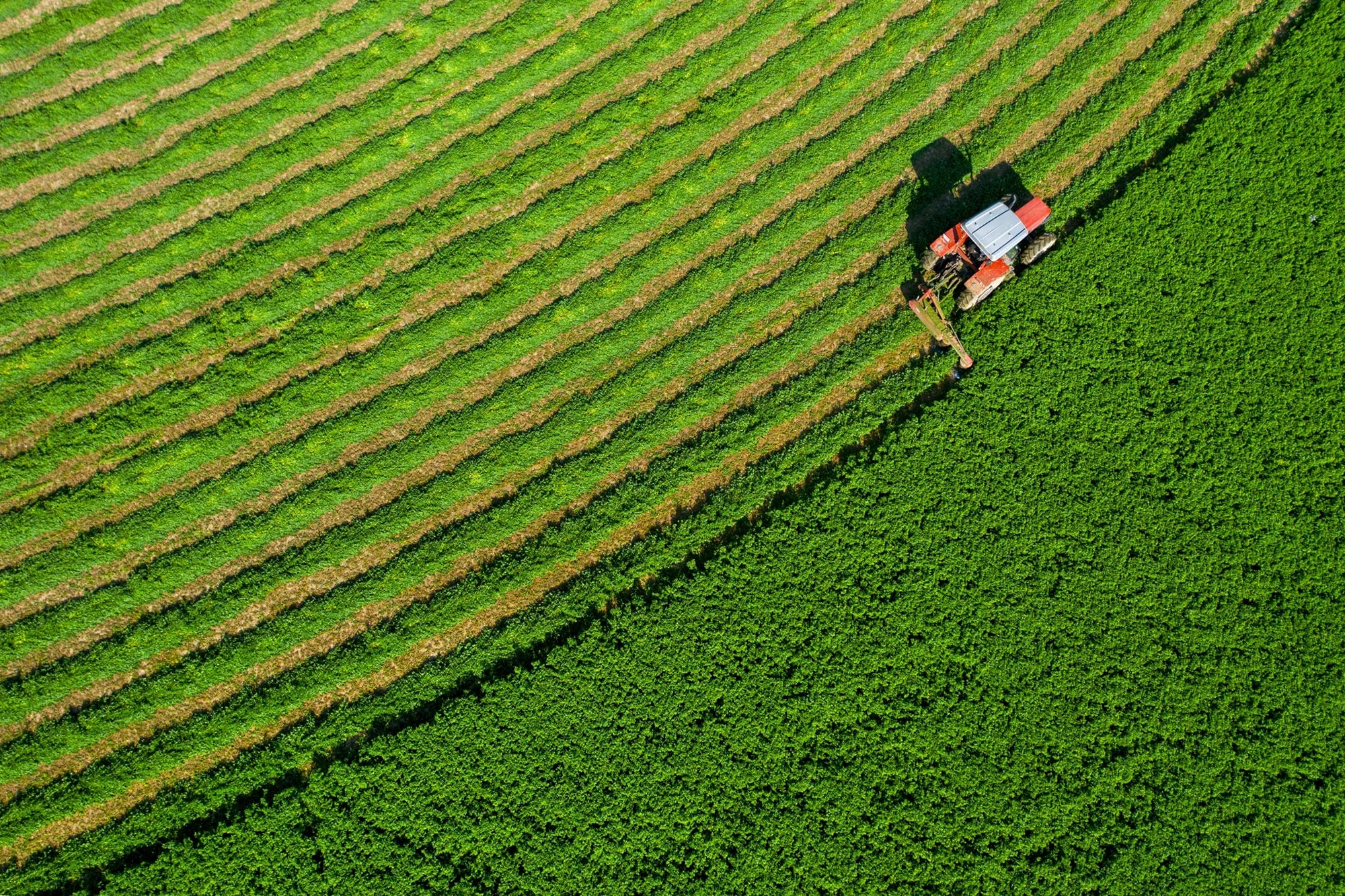
A worldwide move toward healthier diets, more efficient farming, and less food waste could dramatically reorganize global agriculture by 2050.
Following global recommendations to adopt healthier diets, make farms more productive, and cut food waste in half could dramatically alter agriculture by 2050. According to new modeling, these changes could reduce the amount of land used for farming by as much as 6% and lower the worldwide value of livestock production by 42% ($630 billion) compared with 2020.
The largest effects would be felt in the livestock sector. By 2050, the production value of ruminant animals (beef cattle, sheep, and goats) could fall by an estimated 70% ($274bn), leaving the world with roughly 400 million fewer of these animals than in 2020.
Plant-based agriculture, however, could expand sharply. The combined global production value of vegetables, fruits, nuts, and legumes could rise by 57% ($890bn).
Modeling a Major Global Food Transformation
The findings come from an analysis published in Nature by researchers at the London School of Hygiene & Tropical Medicine (LSHTM), Cornell University, and 10 modeling teams. The researchers examined what could happen if the world carried out a food system transformation similar to the one proposed by the 2025 EAT-Lancet Commission.
The 2025 EAT-Lancet Commission report concluded that a worldwide transition to healthy diets could prevent 15 million premature deaths every year. Previous studies have also estimated that the current food system creates $10-$20 trillion in hidden costs annually, with unhealthy diets accounting for most of that burden.
These hidden costs include damage that may not appear directly in food prices, such as medical expenses, lost productivity, environmental degradation, and the long-term consequences of poor nutrition.
Major Climate Benefits by 2050
The new analysis suggests that the recommended changes could also deliver substantial environmental gains. Agriculture-related net CO2 emissions caused by land use change could fall by 85% by 2050 compared with 2020.
Land use change emissions are released when forests, grasslands, or other natural environments are cleared or altered for farming. Reducing the need for agricultural land could therefore help preserve ecosystems while keeping more carbon stored in plants and soil.
Dr. Matt Gibson, lead author, who began the work at Cornell University before joining the London School of Hygiene & Tropical Medicine (LSHTM), said: “Transforming food systems would deliver enormous potential benefits to our health and the environment but, as our results make clear, they would also lead to fundamental changes to global agriculture and affect the lives of millions of farmers and food producers.
“Rather than using these results as an excuse for inaction, it’s critical that governments rise to the challenge and make difficult decisions for the good of our health and the planet. This means confronting powerful groups that profit from the status quo and a global food system that currently fails both those who produce our food and those who should be nourished by it.”
A Guide to Possible Futures, Not a Prediction
Daniel Mason-D’Croz, study co-author from Cornell University, said: “We should consider these scenarios not as a forecast of what will happen, but as a useful early guide of where challenges and opportunities may arise. Which sectors would need to contract, and which would need to expand. A transformation of this magnitude cannot begin in 2050. Foresight modeling like that highlighted in this study is a valuable tool to inform actions today for more sustainable, healthy, and just food systems tomorrow.”
The researchers emphasize that their results are scenarios rather than firm predictions. The models are intended to show which agricultural industries might shrink, which could grow, and where governments may need to prepare for major economic and social disruption.
The effects would also differ considerably from one country or region to another.
US Livestock Production Could Fall Sharply
In the United States, total agricultural production value could decline by 21% ($76bn) by 2050 compared with 2020.
That overall decrease would conceal a major divide between crops and livestock. US crop production value could grow by 20% ($40bn), while livestock production value could plunge by 73% ($116bn).
India Could See Agricultural Growth
India could experience a very different outcome. Its overall agricultural production value could increase by 46% ($198bn) by 2050 compared with 2020.
Indian crop production value could rise by 65% ($208bn), while livestock production value could decline by a relatively modest 8% ($10bn).
European Agriculture Could Contract
Across Europe, total agricultural production value could fall by 35% ($190bn) by 2050 compared with 2020.
European crop production value could decrease by 8% ($22bn), while livestock production value could drop by 66% ($168bn).
These contrasting projections show that a global dietary transformation would not affect every agricultural economy in the same way. Some countries could benefit from stronger demand for crops, while others that rely heavily on livestock production could face far greater losses.
Changing Diets Would Not Be Simple
One important limitation is that the study assumed a costless consumer preference shift toward healthy diets (i.e., people change their behavior to demand healthier diets).
In reality, changing the way billions of people eat would be far more complicated. Healthy foods are not equally affordable or accessible everywhere, and dietary choices are shaped by local traditions, cultural expectations, individual tastes, and the foods available in nearby communities.
The researchers therefore caution that their models represent only one of many possible futures. Additional studies will be needed to explore substantially different pathways and determine how policy choices, prices, technology, and consumer behavior could change the outcome.
The authors argue that governments should begin making ambitious policy decisions now. Early action could help protect vulnerable producers and consumers as the food system moves toward diets that are healthier for people and more sustainable for the planet.
Reference: “Food systems transformation would reshape global agriculture” by Matthew Gibson, Marina Sundiang, Daniel Mason-D’Croz, Thais Diniz Oliveira, Felicitas Beier, Lauren Benavidez, Astrid Bos, Maksym Chepeliev, Jonathan Doelman, Shahnila Dunston, Shinichiro Fujimori, Tomoko Hasegawa, Petr Havlik, Jordan Hristov, Jonas Jägermeyr, Marta Kozicka, Marijke Kuiper, Page Kyle, Thijs de Lange, Benjamin Leon Bodirsky, Hermann Lotze-Campen, Hermen Luchtenbelt, David Meng-Chuen Chen, Abhijeet Mishra, Christoph Müller, Gerald Nelson, Amanda Palazzo, Ignacio Perez Dominguez, Alexander Popp, Ronald Sands, Marco Springmann, Elke Stehfest, Timothy B. Sulser, Kiyoshi Takahashi, Gianmaria Tassinari, Ferike Thom, Philip Thornton, Kazuaki Tsuchiya, Willem-Jan van Zeist, Hans van Meijl, Dominique van der Mensbrugghe, Detlef Van Vuuren, Hannah H. E. van Zanten, Isabelle Weindl, Keith Wiebe, Xin Zhao and Mario Herrero, 15 July 2026, Nature.
DOI: 10.1038/s41586-026-10775-2
Never miss a breakthrough: Join the SciTechDaily newsletter.
Follow us on Google and Google News.
Full article can be found at: https://scitechdaily.com/healthier-eating-could-trigger-a-630-billion-farming-shake-up/


