


- Article
- Open access
- Published:
- Yadav Adhikari1,2 na1,
- Mohit Parekh ORCID: orcid.org/0000-0002-5186-068X1,2 na1,
- Neha Deshpande1,2,
- Annie Miall1,2,
- Queenie Cheung1,2,
- Marianne O. Price3,
- Francis W. Price3,
- Vicki P. Losick4 &
- …
- Ula V. Jurkunas ORCID: orcid.org/0000-0002-5059-608X1,2
Cell Death Discovery (2026) Cite this article
We are providing an unedited version of this manuscript to give early access to its findings. Before final publication, the manuscript will undergo further editing. Please note there may be errors present which affect the content, and all legal disclaimers apply.
Abstract
Fuchs endothelial corneal dystrophy (FECD) is a progressive disorder characterized by corneal endothelial (CE) cell loss and accumulation of extracellular matrix (ECM) excrescences (guttae) in Descemet’s membrane, leading to corneal edema and visual impairment. We previously demonstrated that ultraviolet-A (UVA) exposure induces oxidative stress and CE cell loss in a non-genetic murine model of FECD. Here, we investigated whether UVA triggers polyploidization, a conserved stress-adaptation mechanism observed in several post-mitotic tissues. Using our UVA-based FECD model, we performed temporal analyses of CE cell ploidy, and molecular markers associated with cell-cycle regulation and ECM deposition seen in FECD. UVA exposure induced oxidative DNA damage and apoptosis, resulting in decreased cell density. Surviving CE cells re-entered the cell cycle and underwent endocycling, generating enlarged polyploid nuclei in about 60% of cells with increased DNA content reaching up to 64 C by day 3, compared to 6 C at day 1 post-UVA. Early polyploidization served a compensatory role preserving tissue integrity following cell loss. However, persistent oxidative stress promoted progression toward endomitosis and multinucleation, accompanied by cellular senescence and fibrosis observed during disease progression. Mechanistically, UVA-induced cell-cycle re-entry and polyploidization were mediated by YAP1 and its downstream effectors, E2F1 and CDK2. Pharmacologic inhibition of YAP1 using the small-molecule CA3 suppressed polyploidization-associated multinucleation and reduced pro-fibrotic changes, ultimately mitigating CE cell loss in vivo. Together, these findings identify distinct early protective and later pathogenic roles of polyploidization in CE cells and highlight YAP1-mediated hyperploidization as a potential therapeutic target for FECD.
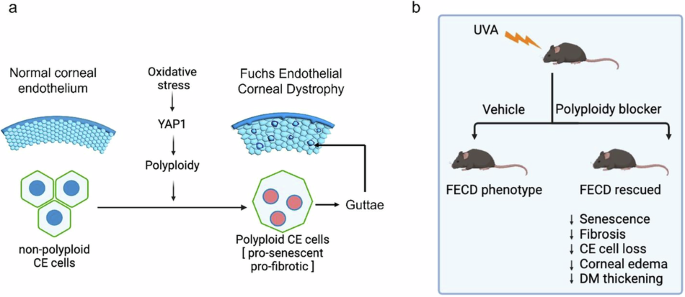
Fuchs endothelial corneal dystrophy (FECD) involves progressive corneal endothelial cell loss driven by oxidative stress. Using a UVA-induced mouse model, we show that surviving cells undergo YAP1-mediated polyploidization. While initially compensatory, persistent hyperploidization promotes senescence and disease progression. Inhibiting YAP1 reduces polyploidy and preserves endothelial cell survival, identifying a potential therapeutic target.
Subjects
Acknowledgements
We acknowledge Prof. Irene Kochevar and Bill A. Farinelli (Wellman Center for Photomedicine, Massachusetts General Hospital, Harvard Medical School, Boston) for their expertise in UVA lamp assembly and in vivo UVA exposure to mice. We are grateful to Mrs. Jaini Parekh (Fig. 1a), Aaron R. Kaufman, MD (Fig. 1b) and Stephan Ong Tone, MDCM, PhD, FRCSC (Fig. 1c). Some illustrations were created using biorender.com.
Funding
The work was supported by NIH/NEI R01EY020581 to U.V.J. and the National Institute of General Medical Sciences of the National Institutes of Health under Award Number R35GM124691 to V.P.L.
Ethics declarations
Competing interests
The authors declare no other competing interests. Certain aspects of the research presented in this manuscript are associated with a filed U.S. patent application 63/878,534 filed on September 9th, 2025, to USPTO. This patent application relates to inhibiting polyploidy as a novel strategy to treat or prevent Fuchs endothelial corneal dystrophy. For further inquiries regarding the patent application or its relation to the manuscript, please contact [email protected].
Additional information
Publisher’s note Springer Nature remains neutral with regard to jurisdictional claims in published maps and institutional affiliations.
Supplementary information
Rights and permissions
Open Access This article is licensed under a Creative Commons Attribution 4.0 International License, which permits use, sharing, adaptation, distribution and reproduction in any medium or format, as long as you give appropriate credit to the original author(s) and the source, provide a link to the Creative Commons licence, and indicate if changes were made. The images or other third party material in this article are included in the article’s Creative Commons licence, unless indicated otherwise in a credit line to the material. If material is not included in the article’s Creative Commons licence and your intended use is not permitted by statutory regulation or exceeds the permitted use, you will need to obtain permission directly from the copyright holder. To view a copy of this licence, visit http://creativecommons.org/licenses/by/4.0/.
About this article

Cite this article
Adhikari, Y., Parekh, M., Deshpande, N. et al. Ultraviolet-A light-induced chronic hyperploidization causes fibrosis in post-mitotic cells affected by Fuchs endothelial corneal dystrophy. Cell Death Discov. (2026). https://doi.org/10.1038/s41420-026-03292-8
Received:
Revised:
Accepted:
Published:
DOI: https://doi.org/10.1038/s41420-026-03292-8


